Author: Brian O’Donnell

  • How AI Is Rewriting the Rules of Art Conservation

    How AI Is Rewriting the Rules of Art Conservation

    “It opens up all these new horizons for art history, for connoisseurship, and for how the discipline is going to continue to form.” 
    — Professor Marc Walton 

    You’ve heard of using AI to make art, but an interdisciplinary team of researchers at the University of Hong Kong is now tackling a far more complex problem: applying AI to the field of art conservation. Their work could have outsize ramifications for the world’s art institutions, expanding access to cutting-edge art conservation tools, cutting the time needed for materials analysis and allowing even small museums to protect and preserve their collections. 

    A Hands-On Approach 

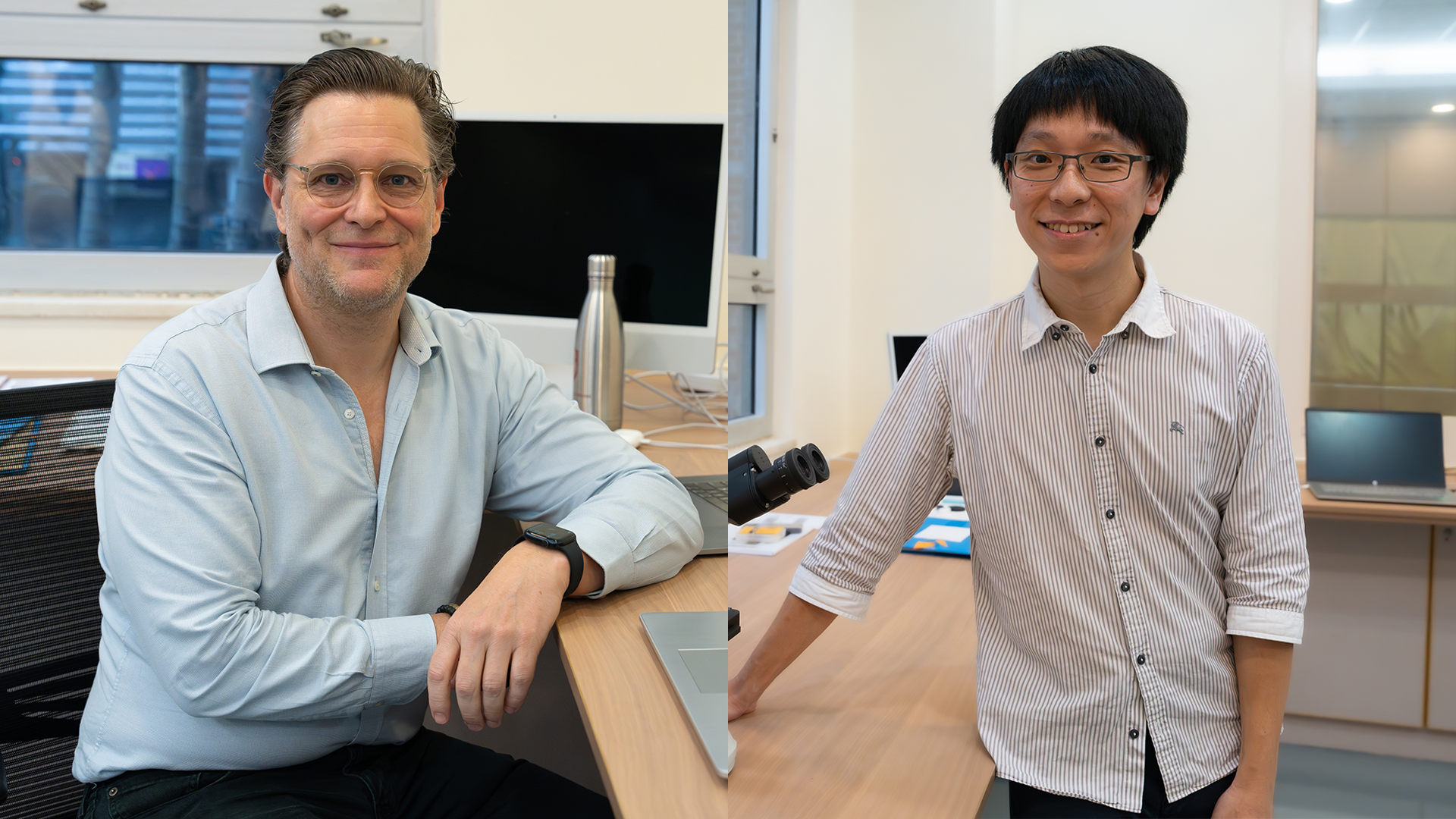
    Tucked away in a corner of the Hong Kong University Museum and Art Gallery is the only on-site, university museum research lab in Asia. There, a team of chemists, conservation scientists, and students under Professor Marc Walton of HKU’s Museum Studies programme and the Department of Chemistry’s Dr Kenneth Ng are developing, building, and experimenting with new instrumentation that could radically lower the barriers to characterising the materials comprising objects of art and archaeology. 

    Looking around the lab, it’s hard to imagine that, a little over a year ago, almost none of this infrastructure existed. Before Walton, who was previously Head of Conservation and Research at M+, joined HKU in 2024, he had never met Dr Ng. They were brought together by another new arrival to the university, Chemistry Professor Jay Siegel, who recognised the pair’s shared interest in both chemistry and mechanical tinkering. 

    For Professor Siegel, the collaboration offered a solution to two longstanding issues in university education: how to break down barriers between disciplines and give students hands-on experience with real-world applications. 

    “(The students) are very well trained, they know their theories, but they’ve never touched an artefact before.” 
    — Dr Kenneth Ng 

    Soon, what began as a series of informal conversations morphed into something very real, with Walton joining HKU, then teaming up with Ng and the Chemistry department to bring their vision to life. “Jay recognised that Kenneth and I were thinking along the same lines,” says Walton. “He couldn’t have been more correct. This is the type of cross-fertilisation you normally wouldn’t think about: bringing a chemist together with someone from the humanities.” 

    Bridging Art and Science 

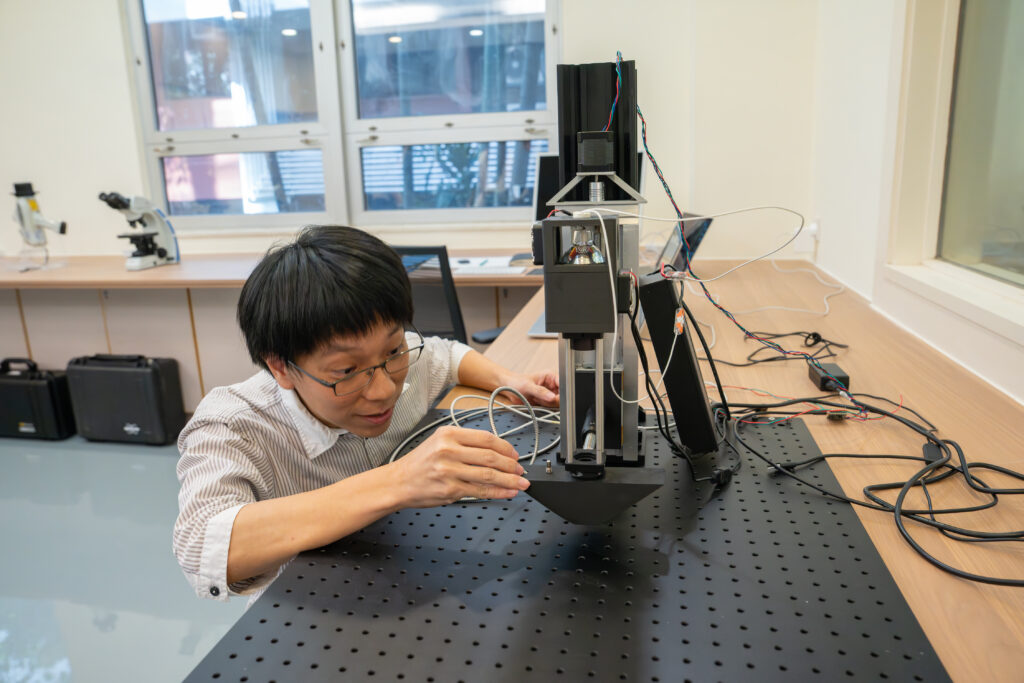
    Viewed from the front, the UMAG lab’s“Franken-camera” doesn’t look particularly unusual. It’s only when you circle around back that the moniker’s logic starts to come into focus, revealing uncovered wires and chips that have been grafted on by the team to improve performance. 

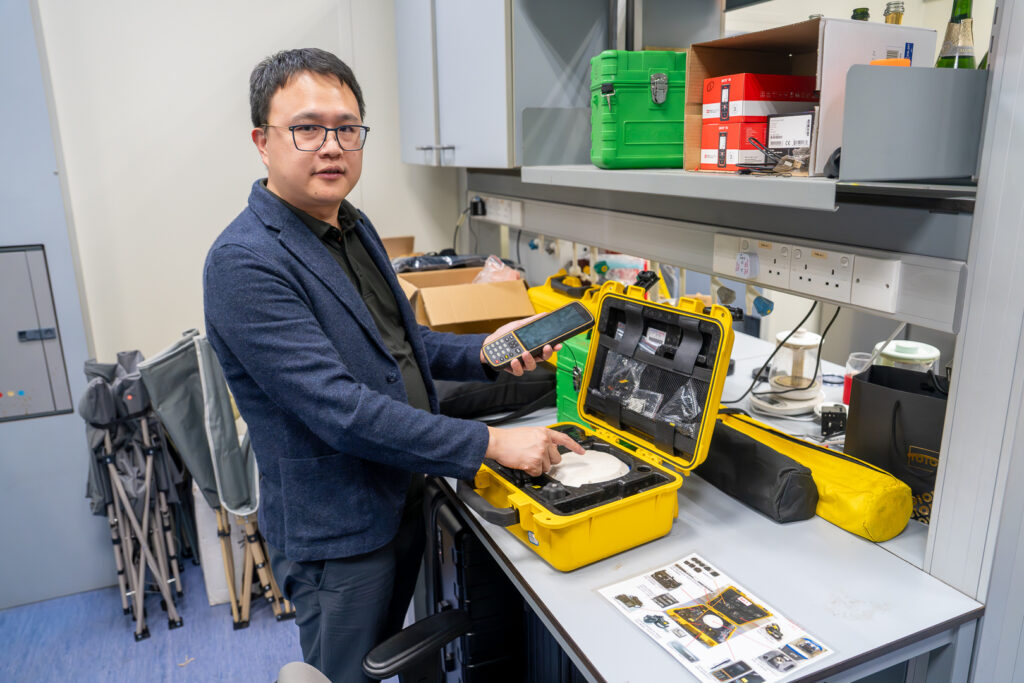
    The Franken-camera is far from the only curious-looking tool in the lab. The team uses a wide variety of analysis instruments, from off-the-shelf items like the handheld XRF spectrometer – designed to mimic the look of a Star Trek phaser – and modified microscopes. Their commitment to home-brewed tech isn’t just about performance or customisability; by opting to custom build tools, they give students more opportunities to practice a variety of skills that could be useful for their futures, such as the integration of code with hardware. 

    “The one big hurdle that we face in teaching is that ‘fancy’ microscopes are usually very, very expensive and ‘thou shalt not touch it.’” 

    — Dr Kenneth Ng 

    One of the biggest new tools in their toolkit is artificial intelligence. While the underlying machine-learning tech has been around for decades, the proliferation of LLMs and AI applications is drastically shortening the time spent on materials analysis – a key step in the process of understanding and conserving a piece of art. 

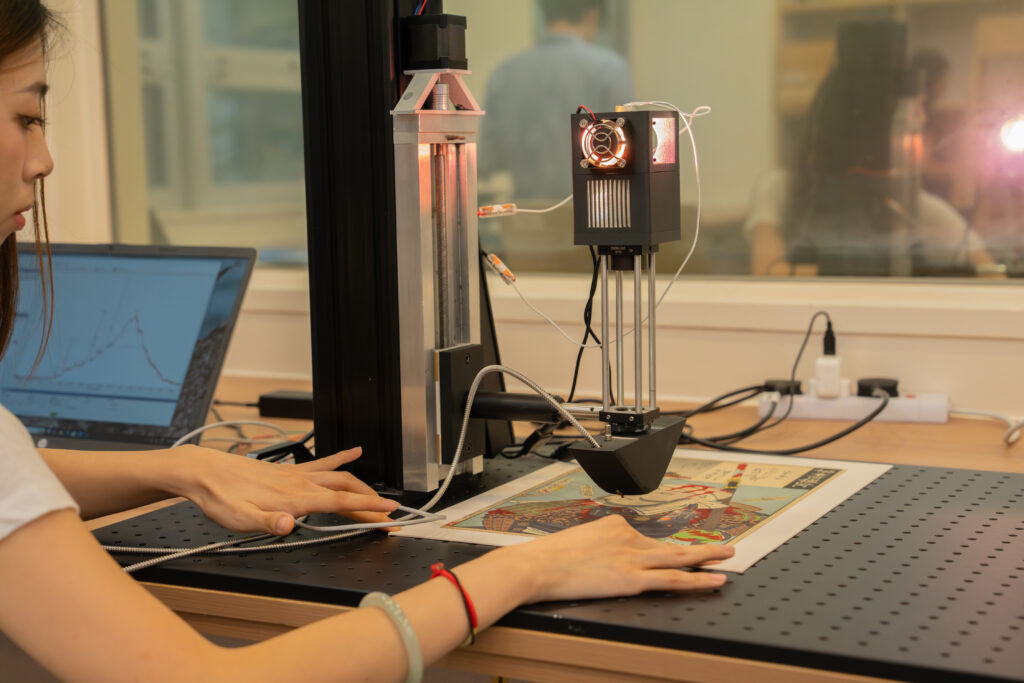
    As an example, Walton points to the traditionally time-consuming task of point analysis of artefacts. AI is allowing the team to take a handful of data points – some with detailed spectroscopic information, others that cover a larger portion of the artefact and show spatial details – and merge the sets to produce an image cheaply and quickly. 

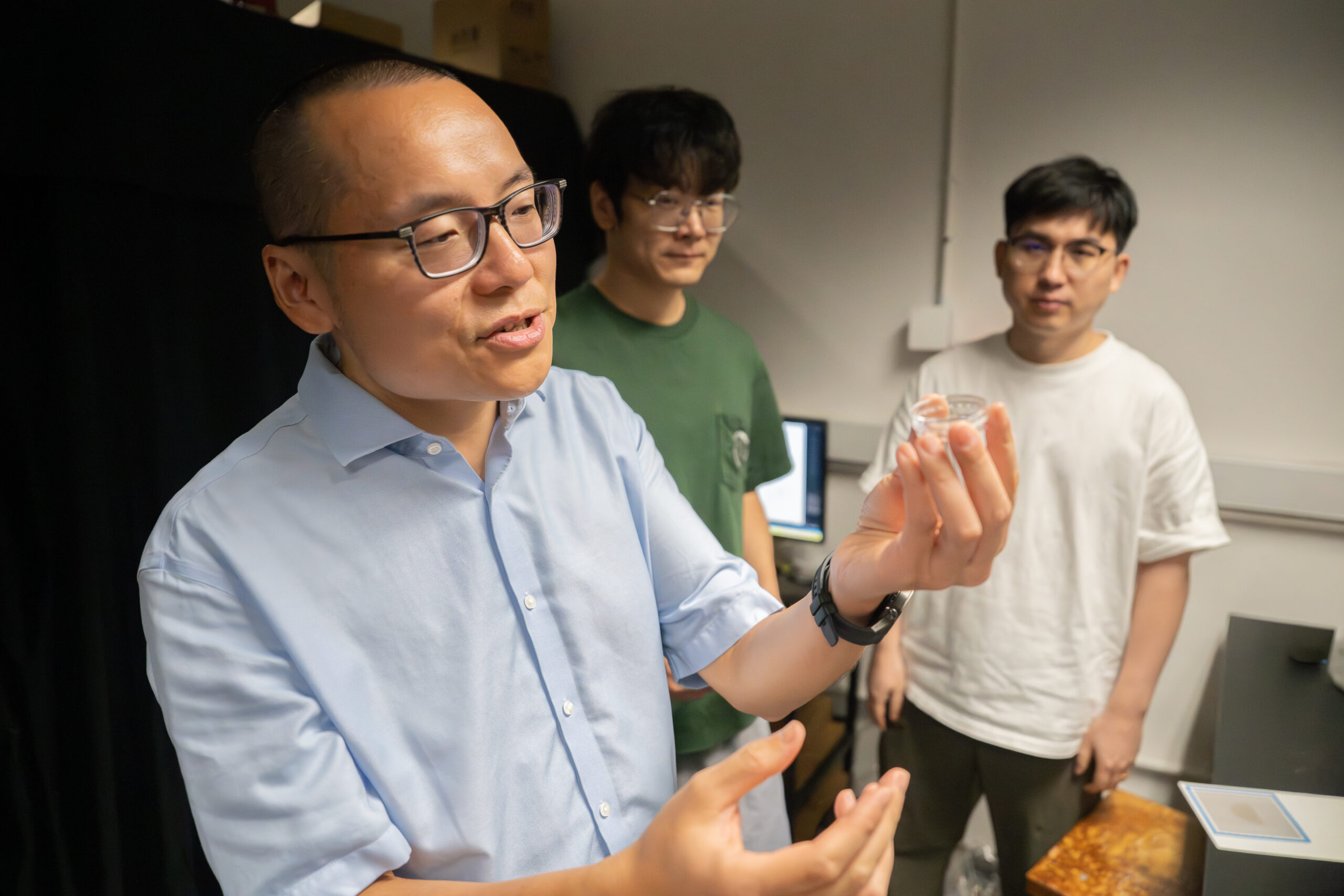
    Dr Kenneth Ng inspects one of the lab's instruments

    Expanding Access Through AI

    “AI allowed us to do that. Before, it was really difficult to be able to fuse these different things together, to be able to create something that combines the best of both worlds.” 
    — Professor Marc Walton 

    Both Walton and Ng spotlight AI’s impact in expanding access to art conservation. Traditional conservation characterisation methods are expensive and difficult to use, leaving institutions across the globe struggling to balance their desire to augment the value of their collections through study and treatment with the associated costs of bringing science into the museum.  

    If the cost of conservation tools and processes could be brought down, the thinking goes, then many of these problems could be solved with some basic technical knowledge and a little ingenuity.  

    “These are things that any museum around the world, any person that’s interested in duplicating our work, could conceivably be able to do it without spending a whole lot of money,” says Walton. 

    A student uses an AI-powered tool to perform analysis on a sample work of art.

    The Future as Blank Canvas  

    The team cautions that AI isn’t a cure-all, and that many of the classical methods of conservation continue to work well. Rather than completely overturning the field’s received knowledge, they’re focused on teaching students how to develop and use new tools while maintaining a critical mindset. 

    “It’s very important for students to know the nuts and bolts of AI rather than just using it as a black box,” says Ng, using a common metaphor for the opacity of AI algorithms. “Especially as a scientist, you really need to put on that scientist hat and differentiate whether it’s hallucinating, or whether it’s giving you the right answers.” 

    Still, they remain excited about the tech’s potential for conservation, with Walton pointing to possibilities, not just for the museum world, but also for lowering the barriers to connoisseurship and changing the field of art history. 

    That’s not all: Asked whether AI can bridge the gap between objective and subjective analysis, Walton pauses for a moment before turning philosophical. “I always think the objective and subjective come together, because the agency of the artist is in the materials, which we can be objective about” he says. “But really, what we want to understand is the subjective part of it. So, we’re using science as a tool to assess the subjective.” 

    To learn more about how Professor Walton and Dr Ng are using AI to rewrite the rules of art conservation, watch the video below:

  • On Red Tides: How Wang Mengqiu Is Tracking Algal Blooms With AI

    On Red Tides: How Wang Mengqiu Is Tracking Algal Blooms With AI

    Forests aren’t the only fragile ecosystems at risk from climate change. In the right conditions, Sargassum, a kind of macroalgae, can trap vast amounts of carbon and store it at the bottom of the ocean. But what happens when those conditions change? 

    The University of Hong Kong’s Professor Wang Mengqiu doesn’t want to wait to find out. Working with satellite imagery and advanced AI algorithms, she’s tracking oceanic conditions, monitoring blooms, and trying to answer an all-important question: How much of a given Sargassum bloom will become a carbon sink – and how much will wind up a carbon source? 

    Across the sea 

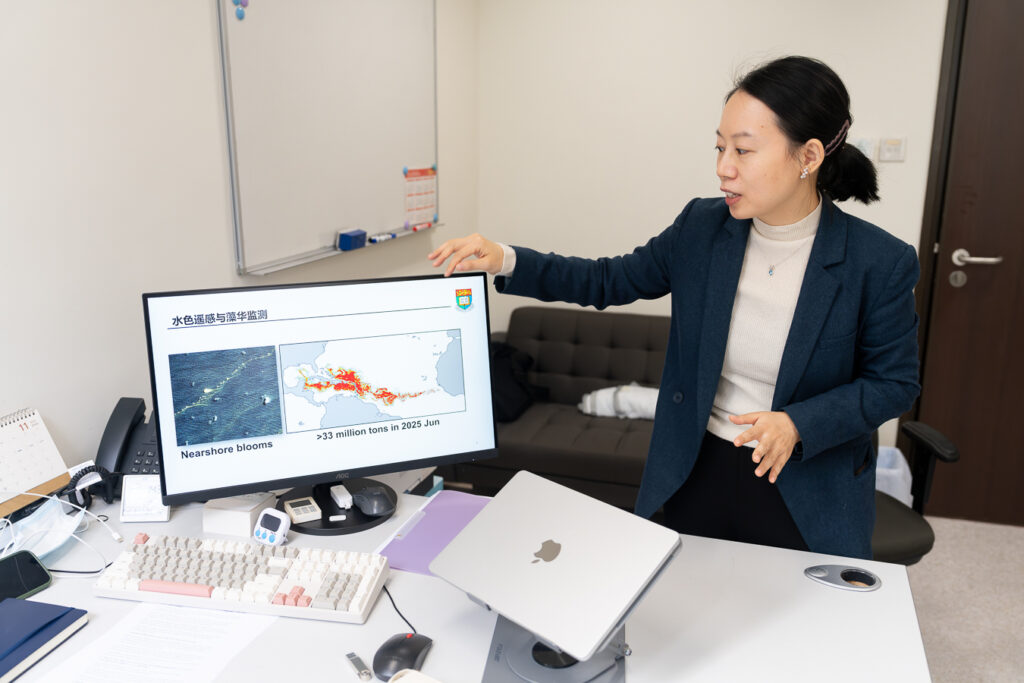
    The scale of Sargassum blooms can be hard to comprehend. To demonstrate what the planet is facing, Professor Wang pulls up a map showing the Great Atlantic Sargassum Belt, which stretches from the western coast of Africa across the ocean to the Caribbean and Mexico. 

    A recurring natural phenomenon, the Belt was observed as early as the late 15th century. “The ocean can benefit from Sargassum,” Professor Wang says, adding that they are “very big players in the ocean carbon cycle.” 

    Yet the Belt’s recent growth has worried researchers, as blooms set historical highs and landfall events in the Western Atlantic smother beaches and coastal wildlife.  

    “Satellites are an ‘eye in the sky,’ giving us a synoptic view of what’s happening below.” 

    – Professor Wang Mengqiu

    “In the open ocean, Sargassum acts as a carbon sink,” Professor Wang explains. “But if it reaches the coast, it releases hydrogen sulfide (a compound linked to asthma) and endangers coastal vegetation, including corals and seagrasses.” 

    Step one in addressing the problem is figuring out just how large the Belt has become – and where and when landfall events are likely to occur. But how do you measure something that spans an entire ocean? 

    Professor Wang shows the scale of the Great Atlantic Sargassum Belt
    Professor Wang shows the scale of the Great Atlantic Sargassum Belt

    AI in the sky 

    Typically, tracking Sargassum blooms might involve observations from a boat.  

    Both of these methods are expensive and time-consuming. So researchers like Professor Wang are turning to satellite and remote sensing technology, leveraging tools like AI and big data to quickly and efficiently identify Sargassum patches and map their locations. 

    Using satellites designed to monitor colour changes in the ocean, scientists can get a much better idea of how big the Belt – actually a thousands-of-miles-long stretch of discrete blooms – really is.  

    Although the underlying technology has been around since the 1980s, the field has benefitted in recent years from new hyperspectral sensors, higher-resolution images, and the shift from machine learning to deep learning. 

    “We don’t want to just react, we need to be able to make predictions.” 

    – Professor Wang Mengqiu

    The launch of NASA’s Plankton, Aerosol, Cloud, ocean Ecosystem (PACE) Satellite in 2024 was particularly exciting, Professor Wang says. “The satellite is a game changer because it’s hyperspectral,” she explains. “It will give us a much finer, more detailed knowledge of global changes.” 

    Previously, that level of detail would have been hard to analyse. But new deep learning techniques are making even hyperspectral imaging analysis possible, Professor Wang says. Her own work is one reason why: She just published a paper showing how to automatically de-noise images to better monitor algal blooms.  

    These advances will ultimately make it easier for scientists to predict the size and impact of future blooms, allowing for better management and mitigation. 

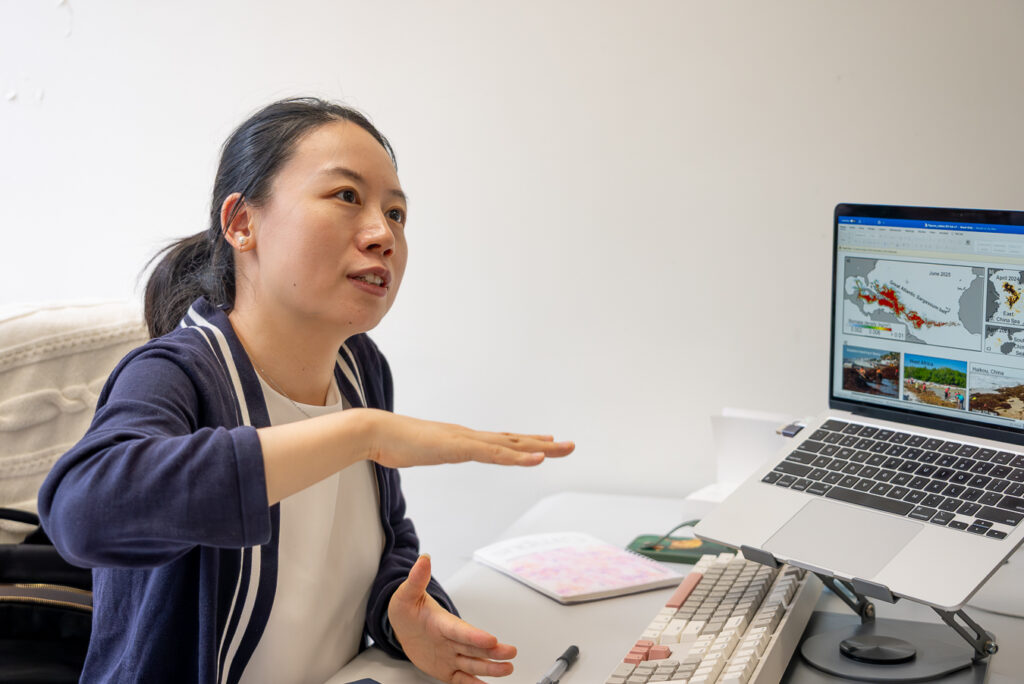
    Professor Wang explains her work using AI to track algal blooms
    Professor Wang explains her work using AI to track algal blooms

    The search for solutions 

    Professor Wang’s next project is to develop algal bloom distribution maps that can be used to guide policymaking. 

    The Atlantic isn’t the only ocean facing growing problems related to Sargassum. In the Yellow Sea and East China Sea, for instance, blooms have caused havoc in recent years.  

    Professor Wang hopes to work together with the Hong Kong government to understand public needs and design real-world applications for researchers’ growing trove of remote sensing data, including alarm systems for Sargassum landfall. 

    “The goal is to convert Sargassum into something useful: energy, building materials, or other applications.” 

    – Professor Wang Mengqiu

    While these ideas are still a long way off, she believes they could one day help mitigate or even eliminate the damage done by Sargassum to coastal ecosystems like Hong Kong’s – and even help vulnerable populations like the city’s fishers. 

    “I want to convert satellite products into something broadly useful,” she says. “As scientists, we have to serve the community.” 

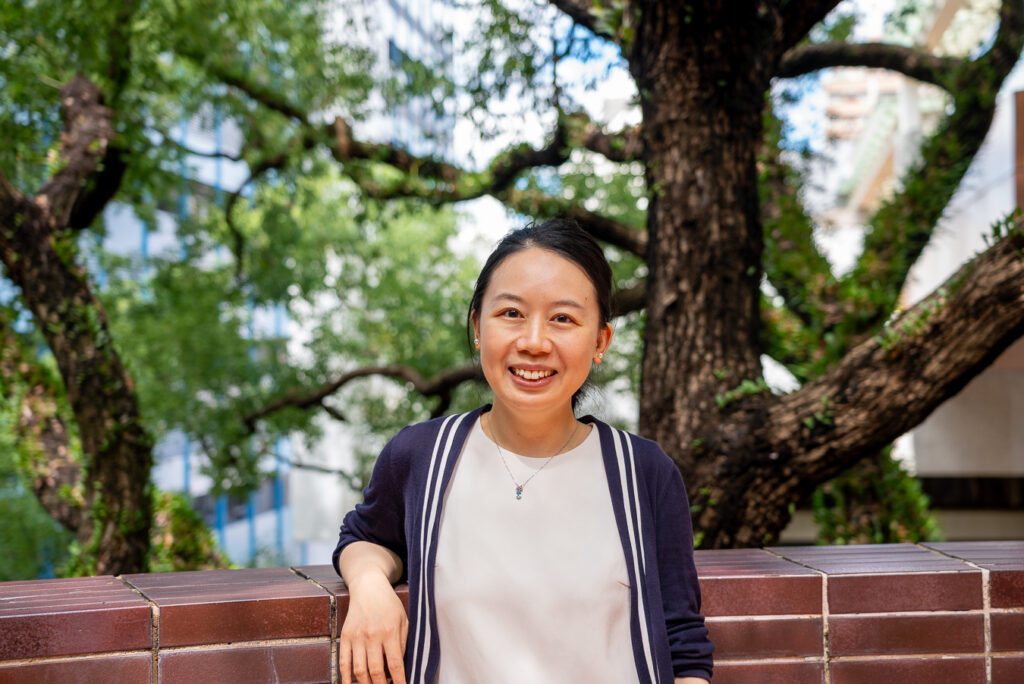
    Professor Wang poses on the HKU campus
    Professor Wang poses on the HKU campus
  • Jin Wu Wants the World to See the Forest for the Trees

    Jin Wu Wants the World to See the Forest for the Trees

    When most people look at a forest, they see an example of nature at its best, a planetary lung that is one of our most reliable defences against climate change. But University of Hong Kong Professor Jin Wu sees something else: a delicately balanced ecosystem that, if not properly managed, could play havoc with earth’s future.

    That’s because not all forests are created equal. The Amazon, for example, was traditionally dominated by evergreen trees. More recently, however, a mix of environmental changes, drought, and human encroachment have led many of these to die off and be replaced by deciduous variants.

    While it’s too early to say how this will impact the climate, the end result could be a vicious cycle, Professor Wu says. As temperatures rise, trees need more water to sustain themselves. If the water runs low, more evergreens die and are replaced by deciduous trees, which do not transmit water from the soil to the air as efficiently. That means less rainfall and even more evergreen loss, releasing their stored carbon into the atmosphere as part of a process scientists call “Amazon dieback.”

    “People think of forests as a way to fight climate change, but they can also facilitate climate change.”

    – Professor Jin Wu

    All is not lost, however. Professor Wu and his team are among the many scientists working to understand and track changes underway in the Amazon, in his case, through satellite data and remote sensing. “Remote sensing lets us scale up the knowledge we have of individual leaves and plants to a global level,” Professor Wu says with a characteristic smile. “Then we can turn that global knowledge into science-based decision-making.”

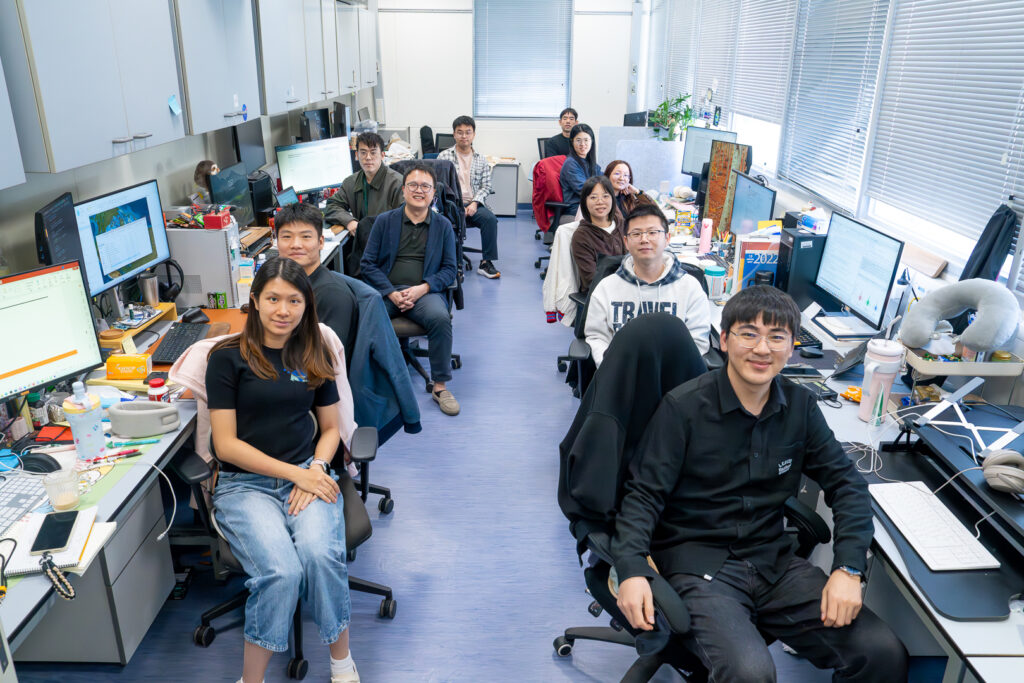
    Professor Wu poses with his students in his lab
    Professor Wu poses with his students in his lab

    From tree to forest

    The field of remote sensing is developing quickly, thanks in large part to new tools like machine learning and AI algorithms, Professor Wu says. One of the most exciting developments his team is working on is using satellite data to track the chemical fingerprint of individual plants, offering an unprecedented window into forest composition.

    The idea comes from a 2009 study by ecologist Dr Greg Asner, who figured out how to identify individual plant species based on the chemical compositions of nitrogen and phosphorus. Because these plant chemical traits interact with light in different ways, satellite imagery could theoretically allow scientists to identify the functional composition of an entire forest.

    “Plants all have unique chemical fingerprints, and remote sensing plus AI can help us identify them.”

    – Professor Jin Wu

    The key hurdle is data. Commonly used hyperspectral imaging techniques are prohibitively expensive and time-consuming. A few years ago, generating a hyperspectral image for a 300-by-300-meter plot cost around HK$20,000.  

    In search of an alternative, Professor Wu’s team turned to a multispectral approach. By looking at 10 criteria across dense image time-series within a year – as opposed to the over 100 needed for hyperspectral imaging – they believe they can develop a complete picture of plant coverage and the underlying high-dimensional chemical compositions around the world at a fraction of the cost. 

    If it works, it could allow scientists to track how plant species are changing across both space and time. And that knowledge, Professor Wu says, might prove vital in the fight against climate change.

    Professor Jin Wu shows off some of the equipment he uses to monitor changes in forests.
    Professor Jin Wu shows off some of the equipment he uses to monitor changes in forests.

    Shrubs and CPUs

    Professor Wu and his team aren’t just looking at the Amazon. They’ve also trained a machine learning model to identify shrubs in the Inner Mongolian grassland. Long-term, they plan to map vegetation across the steppe, keeping an eye on this important ecosystem.

    Crucially, because their data is compatible with long-running databases, they can also look backward in time, allowing them to study the changes that have already taken place over the past 30 years. 

    “The field is evolving very quickly, and a lot of things we’ve never even dreamed of will soon be possible.”

    – Professor Jin Wu

    AI has helped make this possible, Professor Wu says, but the computational power needed represents a strain on the resources of smaller labs. Ideally, AI resources could be centralised so they benefit multiple teams at once – what he calls a “centralise and service” approach.

    Science with a smile

    Despite the challenges, Professor Wu remains optimistic about the future of remote sensing.

    His sunny attitude toward the sometimes slow speed of research progress is reflected not just in his near constant smile, but also in the list of advice for new PhD students on his office whiteboard, which includes both old saws like “be patient” and reminders to “be generous to yourself” and to not think of yourself as purely a helper. 

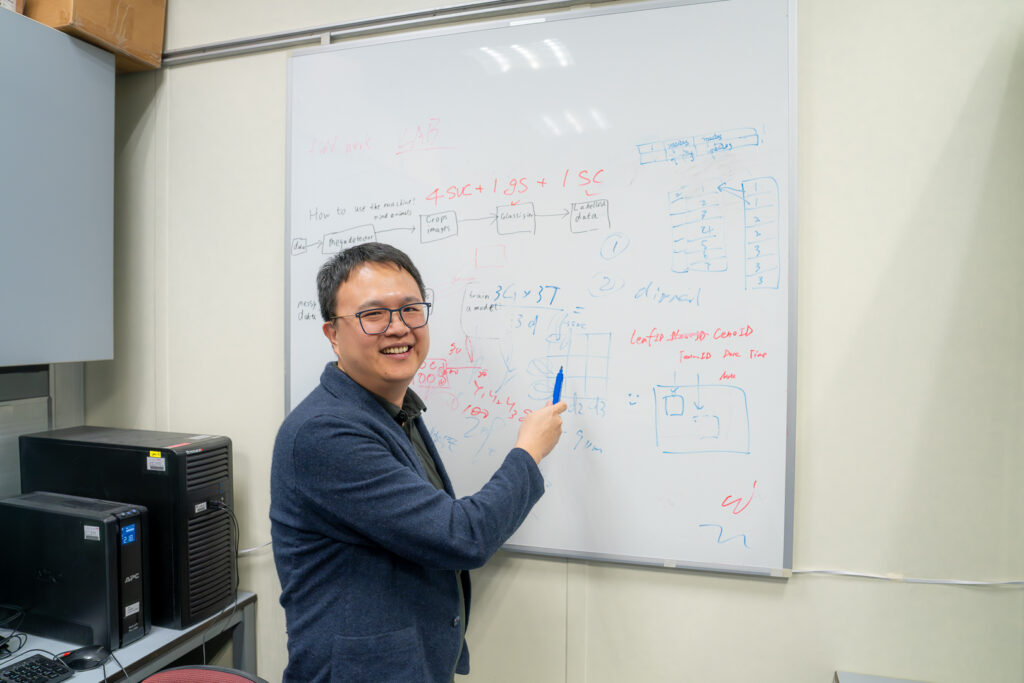
    Professor Wu stands in front of a whiteboard
    Professor Wu almost always has a smile on his face, even when explaining complex science.

    There’s also an item on there about the importance of the spirit of “discovery,” rather than just safely trying to refine existing methods. It’s advice he appears to have taken to heart, as even the mere mention of remote sensing’s prospects in the coming decades causes him to wax excitedly about new mechanisms and techniques that could revolutionise our understanding of the planet. 

    “This is an important field for the 21st century, and we’re well placed to connect science and policy,” he says. “I just hope the University of Hong Kong can leverage this curve and pioneer novel research.”

  • Can Satellites Point the Way to More Liveable, Sustainable Cities?

    Can Satellites Point the Way to More Liveable, Sustainable Cities?

    In just 40 years, China went from a predominantly rural society to a highly urbanised one. What happened? And what lessons can other urbanising regions around the globe draw from that experience? 

    University of Hong Kong Professor of landscape architecture Bin Chen believes we can find the answers in satellite data. An expert in remote sensing and Director of HKU’s Future Urbanity and Sustainable Environment (FUSE) lab, he’s using satellite imagery to track everything from the historical growth of cities to emerging problem areas like urban heat, air pollution, and green/blue space loss. 

    It’s a cutting-edge field – and one with implications far beyond China. Done correctly, it could provide one of the first-ever windows into how cities grow and evolve in the real world. This emerging “urban intelligence” will in turn have major ramifications for rapidly urbanising countries across the Global South, allowing them to avoid mistakes made by other cities while empowering them to create more equitable built environments for all residents.  

    We asked Professor Chen to share his thoughts on the nature of his work, the importance of remote sensing and AI to urban planning, and how the world can build more equitable cities. 

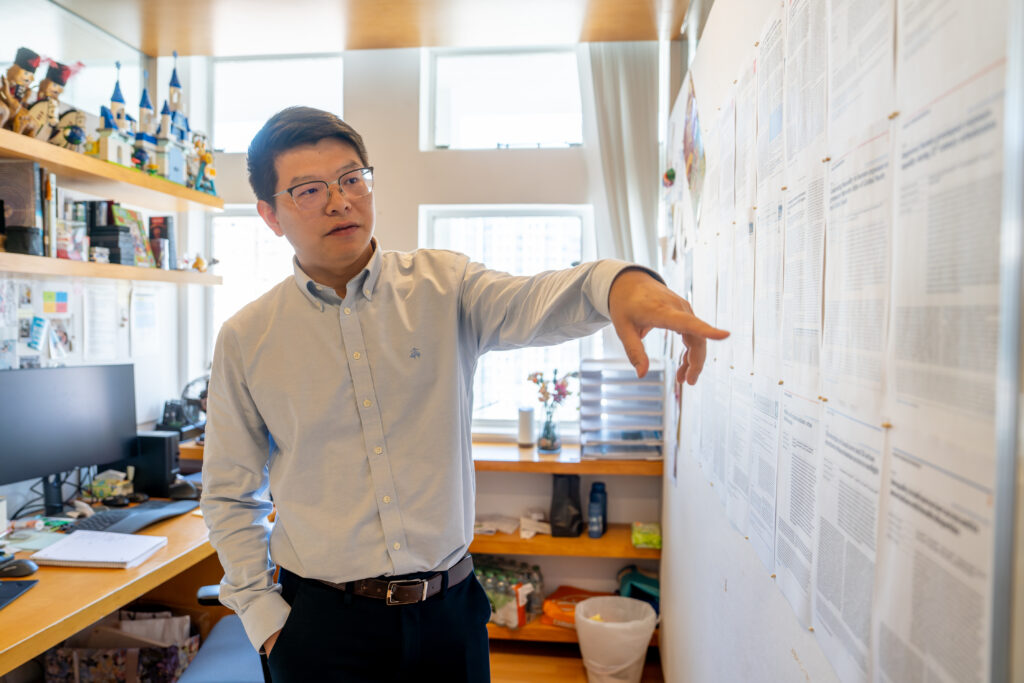
    Professor Bin Chen points to some of his research on satellites and urban intelligence
    Professor Bin Chen points to some of his research on satellites and urban intelligence

    The “intangibles” of sustainability 

    Professor Chen characterises his work as looking at the “tangibles and intangibles” of the built environment.  

    The tangibles are relatively straightforward. But the intangibles – air, heat, sunlight, light pollution, shade, and noise – play just as important a role in our lives and health, while being much harder to quantify. 

    That’s where satellites can play a role, Professor Chen says, as new data and methods allow researchers to look at cities on a granular level, identifying problematic heat islands, light pollution, and air quality. 

    “It’s not just about climate. It’s also about liveability.” 

    – Professor Bin Chen

    Importantly, these are also problems of equity and ESG, with poorer residents often having to go without access to parks, shade, and clean air.  

    “Take shade, for example,” Professor Chen says. “In a city of high-rises, where you have people living in subdivided units with no access to sunlight year-round, shade is a social issue.”  

    Even if every building in a given district meets regulations, it can be hard to tell what the overall outcome will be – a problem satellite imagery and AI modelling can help solve

    While Professor Chen’s team can identify the issue, he hopes work on the solutions will be an interdisciplinary affair. “We need to bring experts together,” he says. “We need knowledge from social economics, environmental studies, data science, and urban planning.” 

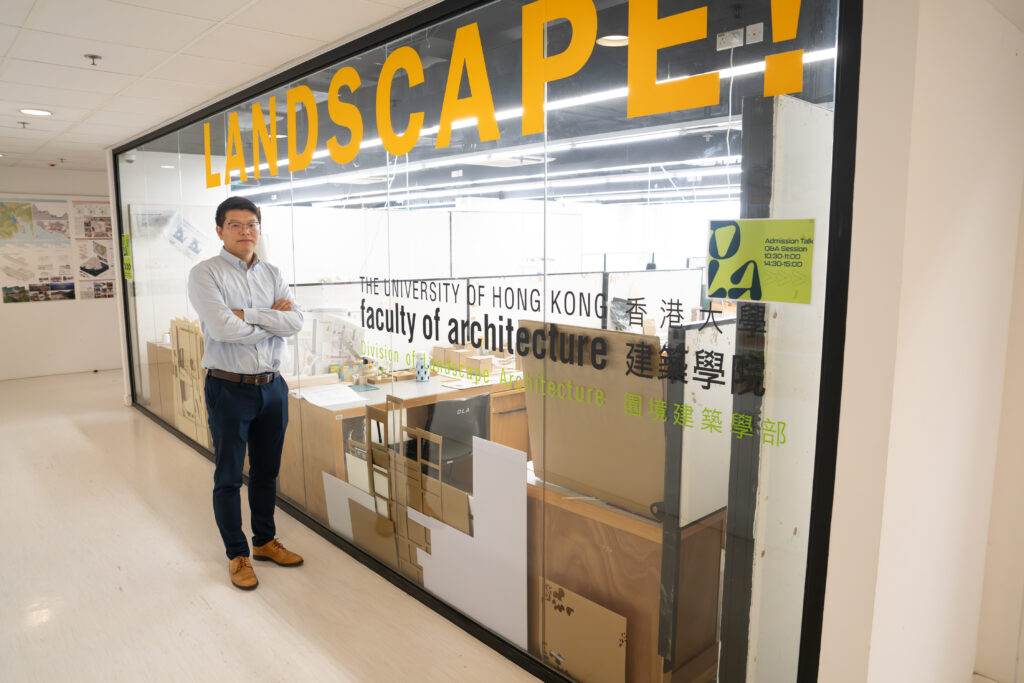
    Professor Bin Chen poses with a sign for the Department of Landscape Architecture and HKU
    Professor Bin Chen poses with a sign for the Department of Landscape Architecture and HKU

    Urban intelligence 

    The long-term goal is to develop what Professor Chen calls “urban intelligence” – a deeper understanding how people, cars, buildings, and the environment interact – then apply that knowledge to developing regions around the world. 

    Perhaps surprisingly, given their importance in modern life, the actual mechanisms by which cities grow are not always well understood. It wasn’t until 2008, when satellite data became more widely accessible, and 2015, when large-scale cloud computing and machine learning caught up, that researchers could closely examine the growth of modern cities.  

    “AI makes everything more efficient.” 

    – Professor Bin Chen

    Professor Chen points to Shanghai’s Pudong New Area as a classic example, noting that while policy documents offer a window into its growth, remote sensing technology allows researchers a seamless, transparent view of how the district grew into a global financial capital. 

    Leading the way 

    But taking advantage of these advances will require more – and more open – data.  

    Still, researchers can make significant progress via virtual collaborations. A few years ago, Professor Chen worked with HKU Professor Peng Gong and partners from 23 universities and institutes across China on a database of Chinese urban land use.  

    By mixing satellite data with on-the-ground verification, they were able to create the country’s first nationwide parcel-level essential urban land use categories map, allowing researchers to easily compare cities around China, from Beijing to Shenzhen and Wuhan. 

    “Remote sensing is becoming more and more powerful. We used to have to focus on individual cities, but now we can look at entire countries, even the whole globe.” 

    – Professor Bin Chen

    That empowered numerous follow-up studies, and the team hopes to expand their map to the rest of the world in the coming years.  

    “We’re entering a new stage, going beyond remote sensing with multimodal data,” says Professor Chen. “But pushing the field forward will require more data sharing.” 

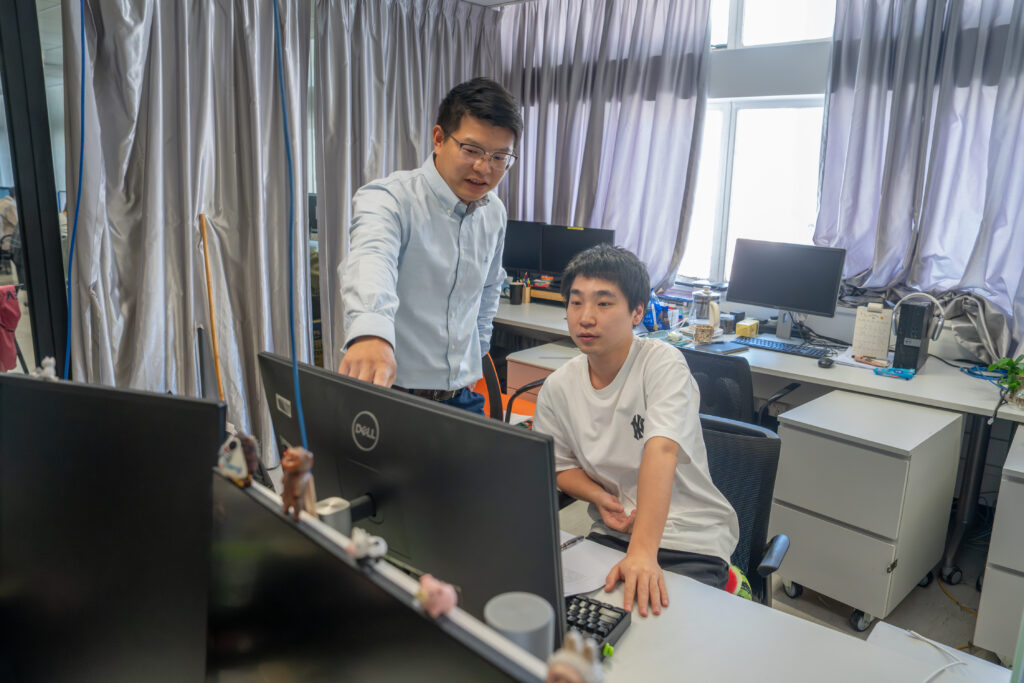
    • Professor Bin Chen, an expert on satellites, remote sensing, and urban intelligence, speaks to a student
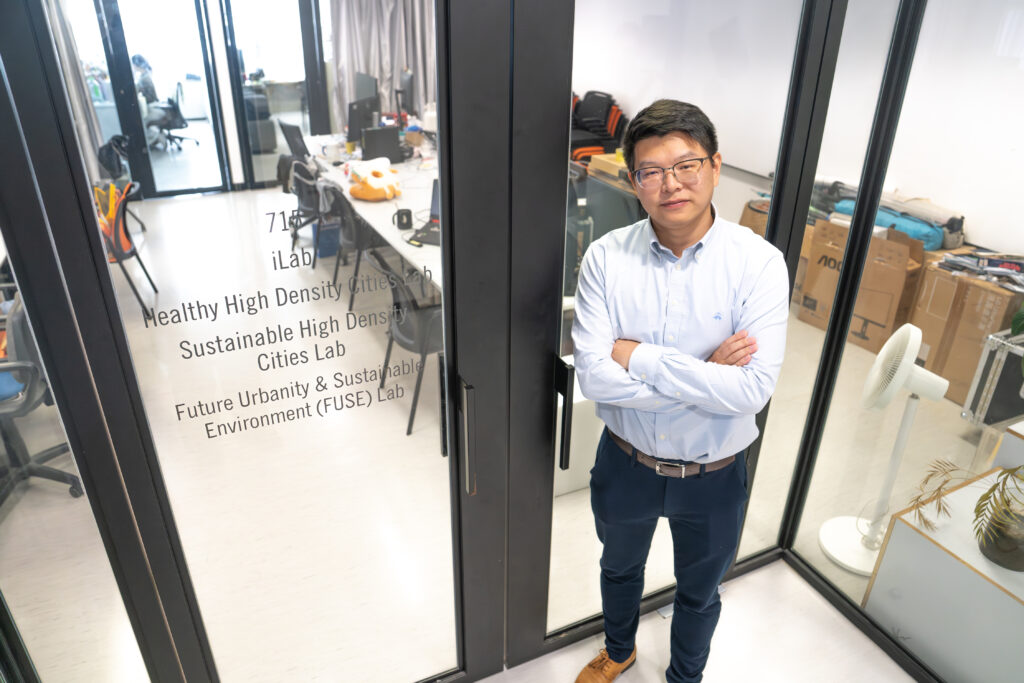
    • Professor Bin Chen, an expert on satellites, remote sensing, and urban intelligence, poses in front of a sign for his Future Urbanity and Sustainable Environment Lab
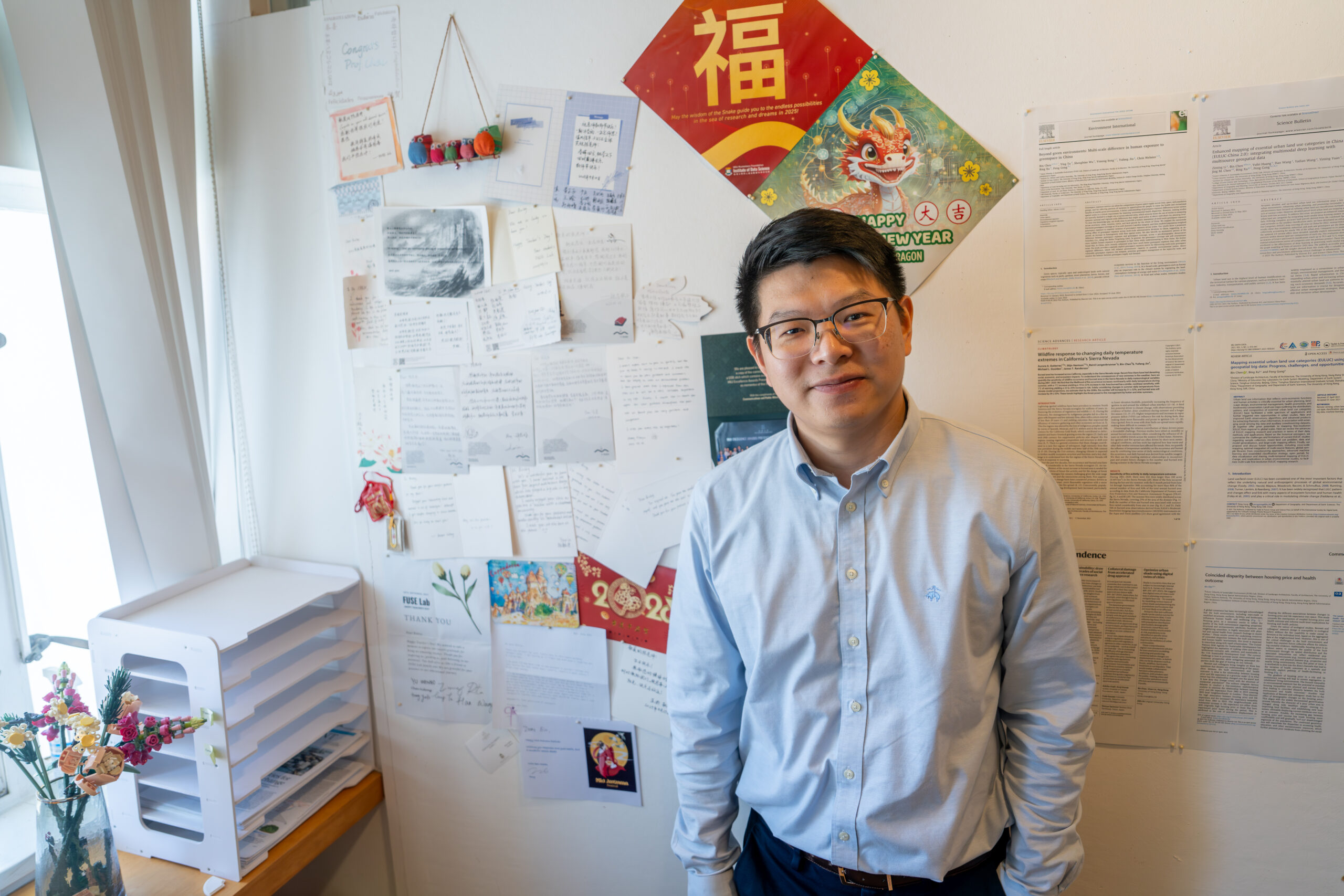
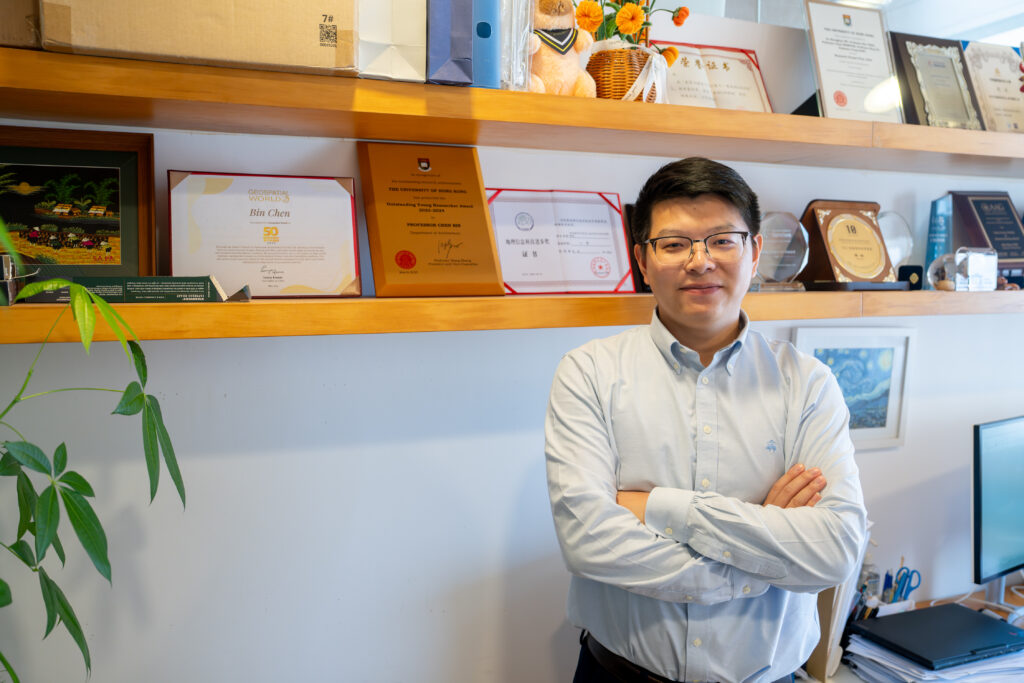
    • Professor Bin Chen, an expert on satellites and urban intelligence, poses with some of his awards
  • Shunlin Liang Wants to Feed the World, One Orbit at a Time

    Shunlin Liang Wants to Feed the World, One Orbit at a Time

    Could satellites one day help us solve pressing socioeconomic problems like food insecurity? What if they could directly tell farmers when to fertilise their crops? Or how much water they should use to irrigate?  

    It sounds like science fiction, but according to University of Hong Kong Chair Professor of Remote Sensing Shunlin Liang, it’s not as far-fetched as you might think. 

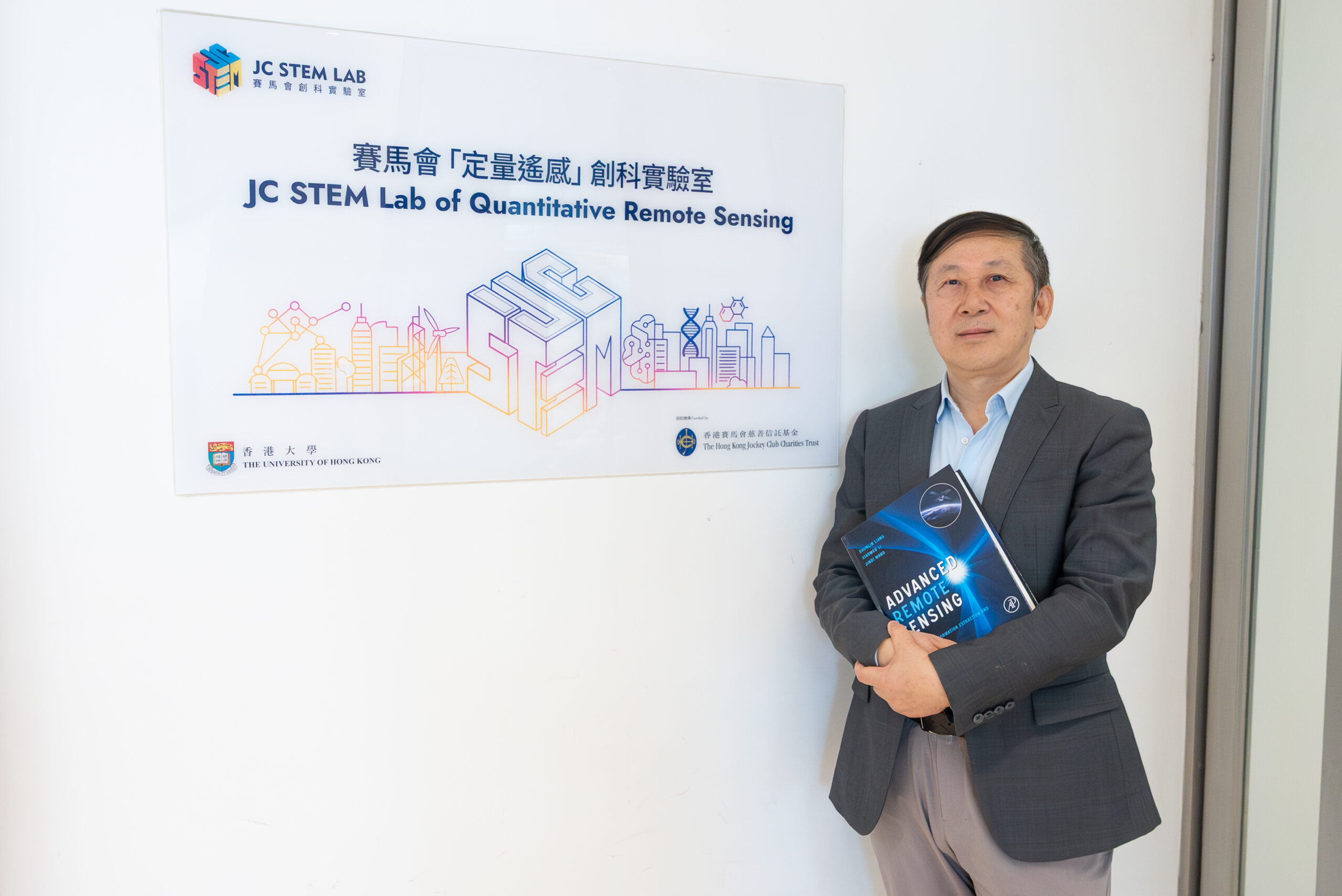
    Professor Liang, who is also the Director of HKU’s Jockey Club STEM Laboratory of Quantitative Remote Sensing, has spent much of his thirty-year career trying to maximise the social benefits of remote sensing and satellite imaging technology. Now he and his team have developed AgriFM, a new artificial intelligence foundation model that could revolutionise how farmers in food-insecure regions manage their crops. 

    We asked him to share his thoughts on his new model, how remote sensing can improve lives around the world, and why it’s so important for researchers to have access to open-source tools. 

    Laying the foundation 

    Roughly half of the people dealing with food insecurity worldwide live in Asia. When Professor Liang saw photos of their plight, it motivated him to take action, and the result of that work is AgriFM, an open-source foundation model that offers superior crop-mapping performance over conventional deep learning methods. 

    While smallholder farmers generally know every inch of their land, managers on larger farms struggle to track crop growth and needs across a wide area. Remote sensing and AI technologies can help, Professor Liang says, allowing them to quickly identify when and where additional water, pesticides, or fertilisers are needed. That, in turn, will save farmers money while boosting yields.  

    “We need to maximise the benefits from minimal inputs.” 

    — Professor Shunlin Liang

    That’s the short-term goal. Long term, Professor Liang says, the technology could prove even more transformative, predicting crop yields months in advance, helping governments and NGOs identify problem spots before they lead to hunger.  

    Open source, open access 

    In some ways, AgriFM is a natural continuation of Professor Liang’s decades-long interest in developing open-source tools and making satellite data more accessible.  

    In 2013, Professor Liang developed the open-source Global LAnd Surface Satellite (GLASS) suite, allowing researchers anywhere in the world to work with satellite data from all the leading public databases. 

    While organisations like NASA and ESA release satellite data to the public, they do not make it cross-compatible. That’s where GLASS comes in, making it possible to achieve much wider coverage by drawing from and unifying data from across various space agencies in one-easy-to-use package.  

    “In the future, foundation models mean we’ll need fewer people working on methodological problems, freeing them to focus on real-world applications.” 

    — Professor Shunlin Liang

    More data means more potential new models like AgriFM, which Professor Liang believes could dramatically change the remote sensing field in the next five to 10 years. Already, he’s working on upgrades to GLASS like High GLASS, which offers greater resolution. 

    “Foundation models will change everything,” he says.  

    A computing challenge 

    That future is still some ways off, however, in large part due to data storage constraints.  

    Thanks to support from the Jockey Club and HKU, his team currently has 10 petabytes of data storage, but Professor Liang has set an ambitious goal of growing that to 50 petabytes in the next few years.  

    “Launching satellites and collecting data is expensive. I don’t want that (data) to be limited to a small community.” 

    — Professor Shunlin Liang

    The idea is to expand the GLASS suite’s impact. To that end, he’s hoping to partner with data vendors and donors to commercialise some products while making others free for use by “millions” of people around the world.  

     “I want to make the data open to everyone,” Professor Liang says. “As a university professor, this is what I should do.”  

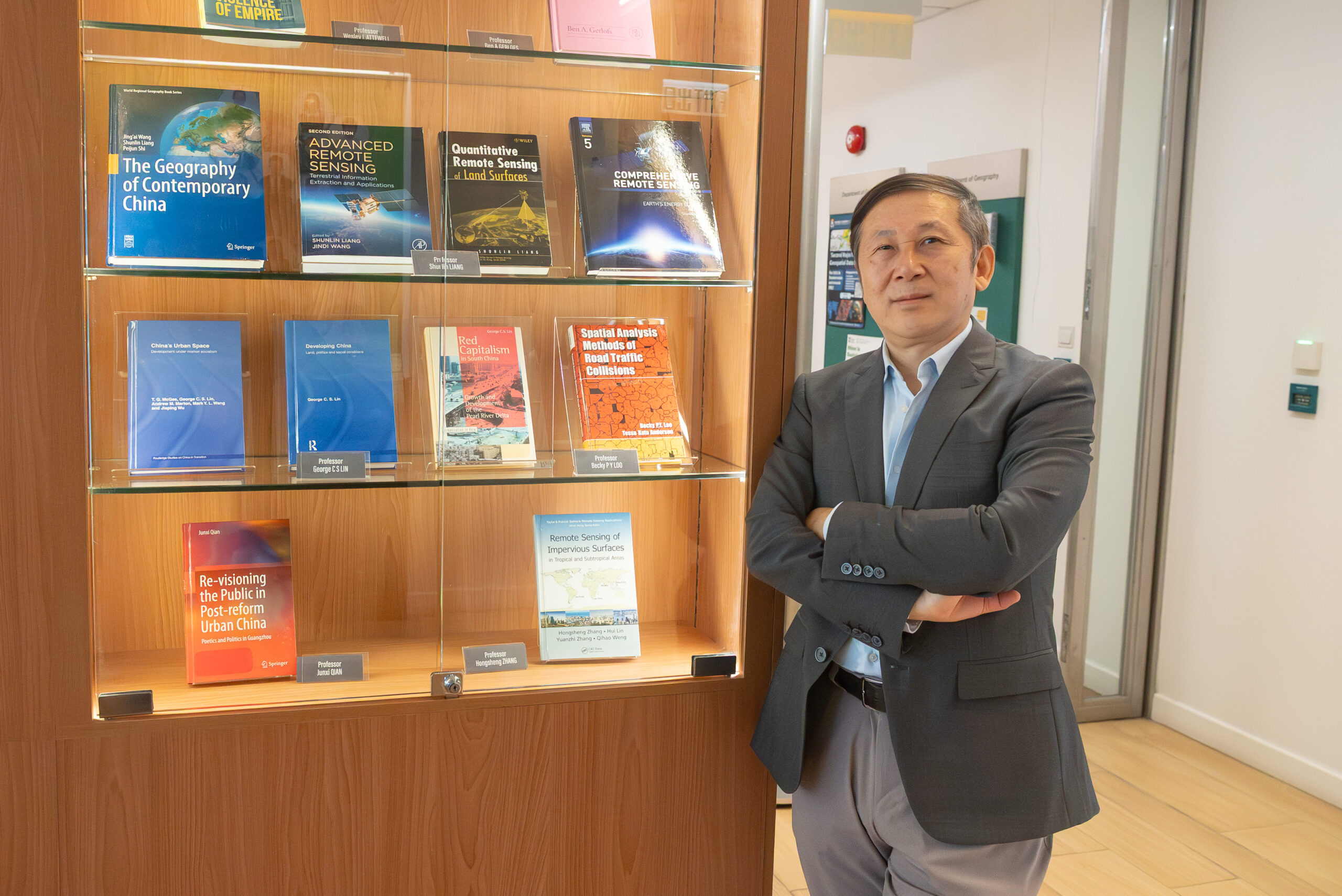
    • Professor Liang, pictured posing, is a global leader in remote sensing. Now he wants to use satellites to solve food insecurity.
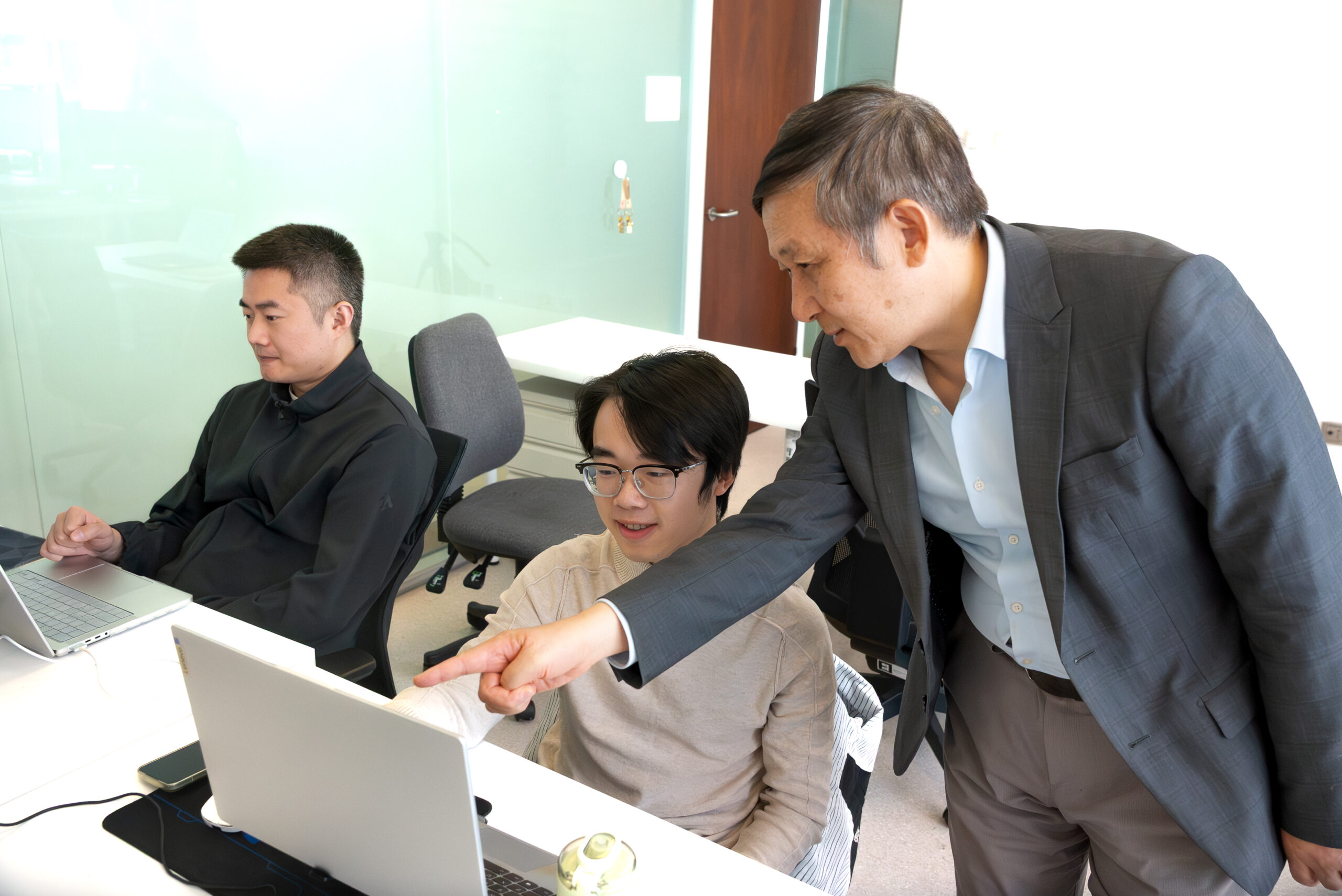
    • Professor Liang, pictured with his students, is a global leader in remote sensing. Now he wants to use satellites to solve food insecurity.
    • Professor Liang, pictured speaking, is a global leader in remote sensing. Now he wants to use satellites to solve food insecurity.
    • Professor Liang, pictured with his students, is a global leader in remote sensing. Now he wants to use satellites to solve food insecurity.
  • To Chu Zhiqin, Diamonds Are Forever – and for Everything

    To Chu Zhiqin, Diamonds Are Forever – and for Everything

    “One of the biggest limitations in fields like AI is power consumption, and the key bottleneck is that their semiconductors are based on silicon.”
    — Professor Chu Zhiqin

    Most people know diamonds as age-old symbols of eternal love, but to the University of Hong Kong’s Professor Chu Zhiqin, they’re the key to our technological future.

    It’s no exaggeration to say that that we’re living in the age of silicon. The element has become the building block of modernity, powering the semiconductors in everything from precision medical equipment to our phones. But silicon is far from an ideal conductor, and scientists have long dreamed of fashioning superior alternatives out of more suitable materials like diamonds.

    The challenge lies in the very attributes that make diamonds so desirable: their durability and toughness. How can you grow diamonds that aren’t just better conductors than silicon, but also have the flexibility needed for the next generation of computing devices, including both power-intensive uses like AI and difficult-to-manufacture wearables? 

    That’s where Professor Chu comes in. His research – for which he was just named a finalist in the prestigious Falling Walls Science Breakthrough awards – is revolutionising the field of diamond-based semiconductors, heralding the future arrival of flexible yet durable chips with more than 10 times the thermal conductivity of their silicon counterparts.

    The Future of Semiconductors

    In theory, diamonds are almost the perfect vehicles for a future “fourth generation” of semiconductors. They are relatively easy to grow – all you need is hydrogen, methane, and electricity – strong, and can handle far higher wattages and more heat than silicon. 

    The trick is in manufacturing. While the basic process is well established, researchers have long struggled to produce diamond structures suitable for next-generation devices like wearables: ones that are flexible without sacrificing durability. 

    Cracking the code took Professor Chu and his team over a year of hard work. But they finally developed a trade secret process that allows them to reliably produce high-quality, micrometre-thin diamond semiconductors that can be rolled and flexed like sheets of paper. 

    “That’s the beauty of being a scientist: You know more about your field than anyone else in the world. If you dig long enough and hard enough, no one will be better at it than you.”
    — Professor Chu Zhiqin

    The Next Generation of Computing

    The barriers to replication are steep: Although the team’s work has already spawned imitators, the competing diamonds tend to crack quickly, Professor Chu says, making them unsuitable for industrial uses.

    The next challenge is commercialisation. Professor Chu is trying to interest manufacturers – always difficult with any new material – and is focusing his energies on high-upside, future-centric sectors like heat spreaders for GPUs and electric vehicles. If they succeed, they could radically increase the efficiency of some of the world’s most important products. 

    Among the developments Professor Chu is keeping his eye on are new AI-based measuring tools. Although accumulating training data remains difficult, AI offers more efficient, dynamic measurements. “Everything can be analysed by AI,” Professor Chu says. “It tells us what the best measurement parameters are.”

    “Basically, the way we’re doing measurements now is the Stone Age, but with AI, we can move forward.”
    — Professor Chu Zhiqin

    A Scientific Spirit

    But Professor Chu isn’t solely fixated on cutting-edge technologies. As the interview winds down, he muses on another significant challenge facing the field: cultivating the next generation of scientists.

    Many aspiring scientists find the process discouraging and gradually drift away from the field. “They think learning math is hard, and learning physics is boring,” he says, adding that they can’t see how they’re supposed to master everything.

    That’s an unfortunate misconception, Professor Chu believes. “Scientists actually are highly specialised,” he says. “It’s not that scientists can solve everything, but we can solve a few, very specific things.”

    This preoccupation is reflected in his lab’s work. When asked what his favourite device is, he doesn’t mention the powerful Zeiss microscope, but a miniature quantum mechanics learning kit developed by one of his graduate students, Madhav. The box allows teachers to show young students quantum mechanics in action, rather than theory, letting them experience for themselves what it’s like to be a scientist.

    It may seem small – or an unusual project for a lab of this stature – but it’s just one more way Professor Chu and his team are shaping the future of science.

  • Reimagining the Future of Work with the Centre for AI Management and Organization

    Reimagining the Future of Work with the Centre for AI Management and Organization

    “My hope is that when people think about issues like AI and organisation, they think about CAMO.” 
    — Professor Jin Li

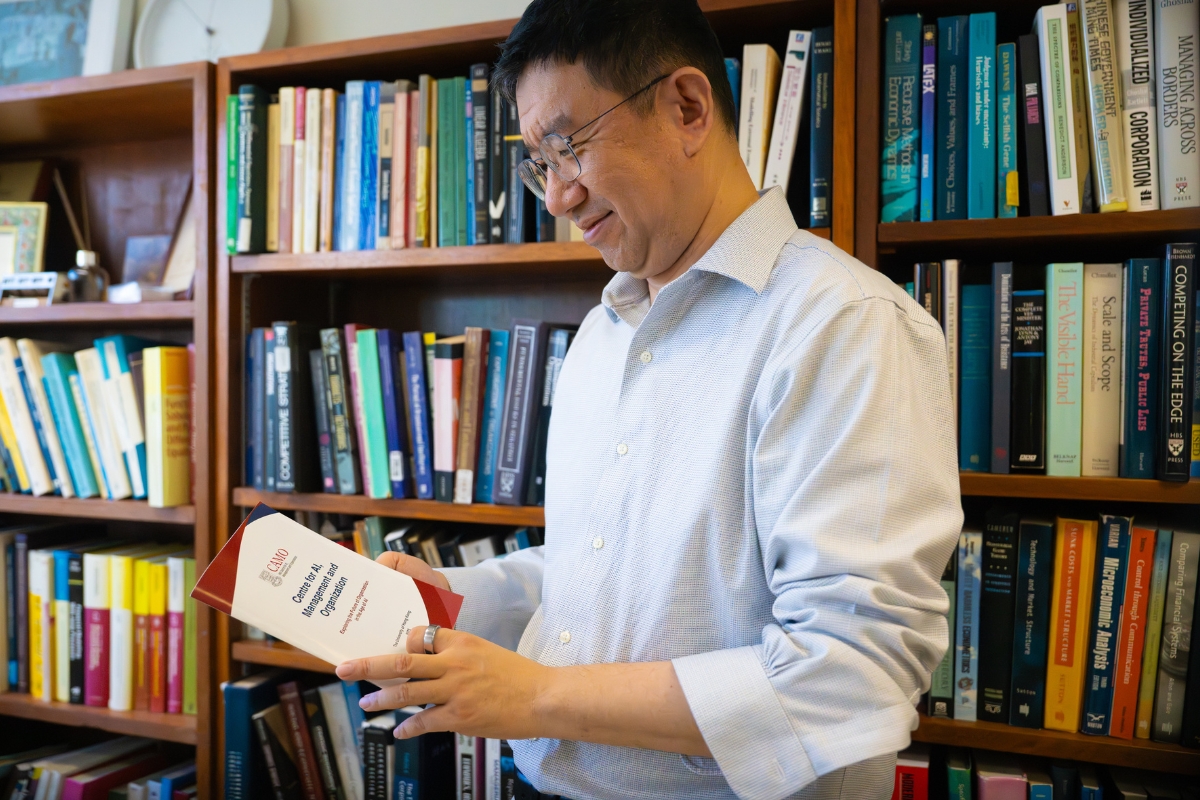
    When Professor Jin Li launched the Centre for AI, Management, and Organization (CAMO) earlier this year, his immediate goal was filling a gap in the scholarship on artificial intelligence and its impact on the future of work.  

    But Professor Li’s long-term vision is even more ambitious: Transforming the University of Hong Kong into a global leader in AI, Management, and Organisation research, positioning it at the forefront of a revolution that will shape the next half-century of work and corporate governance. In his own words, he hopes the centre will contribute the “grand ideas” and frameworks societies need to navigate the AI transition.  

    Drawing on the combined expertise of faculty from across the university – plus a board of advisers featuring members from the University of California, Berkeley, Columbia, the Massachusetts Institute of Technology, the University of Tokyo, and the London School of Economics – CAMO is well on its way to reaching that lofty goal. We asked Professor Li about what drew him to AI, how artificial intelligence is changing the future of work, and what’s next for CAMO.  

    The Pursuit of Happiness 

    When Professor Li was a young student growing up in Shanghai, his school emphasised that the “purpose of life is the search for excellence.” A top student at one of Shanghai’s best schools, Professor Li’s only weak subject was chemistry. The harder he worked and the more he struggled, the more he began to wonder whether there was more to life than excellence – that perhaps the real purpose of life was the search for happiness. 

    He found his answer in an introductory economics class at the California Institute of Technology (CalTech). As his professor explained that individuals maximise utility, he remembers thinking that this seemed an awful lot like maximising happiness. 

    “Now is the best time to study AI.” 
    — Professor Jin Li

    Although not directly involved in AI research at the time, a number of his friends and classmates would go on to play pivotal roles in an earlier wave of the AI revolution, and their work sparked his own interest in the field. Now, as he enters what he calls the “second curve” of life, he sees AI research as both important and a way to pursue a topic that has always interested him. 

    Out of the ‘Stone Age’

    Professor Li is fond of a famous line from Edward O. Wilson, in which the American biologist notes that we live in a world of “Palaeolithic emotions, medieval institutions… and god-like technology.” He envisions CAMO as contributing to the upgrading of those institutions to keep pace with technological change.  

    As an example, he points to the way many firms have struggled to update corporate governance and workplace norms for the AI age. Previously, the ideal firm was mid-sized: big enough to achieve economies of scale, but not so big that it becomes bogged down by bureaucracy – an example of what economists call the “U-shaped” relationship between size and efficiency. 

    “As economists, as management strategy scholars, we don’t have that much to do with technology. We cannot change human nature either. What we can do is to think about new organisations, new institutions.” 
    — Professor Jin Li

    Now, however, the AI boom has helped fuel the rise of both unicorns and tech giants like FAANG (Facebook, Apple, Amazon, Netflix, and Google). That tectonic shift has caught many companies off-guard, with CEOs and even consultants unsure of how to adapt. “Firms need to have a playbook,” says Professor Li. “They need to have a framework for how to move forward.” 

    The Future of Work 

    To help write that playbook, CAMO has already surveyed more than 100 C-suite leaders and 500 HR reps as it works on a practical guide for companies navigating the AI transition.  

    One of the centre’s current points of emphasis is identifying the jobs humans don’t want to do, helping firms to decide on automation priorities without exacerbating popular fears of AI “replacing” workers. This approach is also what sets CAMO apart. “There are very few centres that focus on organisation,” Li says. “It may sound cocky, but I don’t think there are more than three to five institutions in the world with the same calibre of people as us.” 

    In addition to laying the “intellectual foundation” for the study of AI and the future of work through his research at the centre, Professor Li is also hard at work on a new book about “The Great Compression.”  

    “I like to call incentive and knowledge the ‘yin’ and ‘yang’ of AI.” 
    — Professor Jin Li

    The access to knowledge promised by AI has spawned new incentives – to cheat, to game the system, to “shirk” – all of which managers must understand and learn to spot. Professor Li’s book will explore these two sides of AI, as well as their combination, which he identifies as “power.” In the process, he hopes to help managers better navigate both the opportunities and risks of the AI era. 

    If all that seems daunting, Professor Li would likely agree. When asked about the biggest challenges he’s facing, he replies quickly: “Time.” There are so many interesting and exciting potential projects, he explains, but the CAMO team must be selective and focused in its priorities. “It’s such an exciting time that I’m not getting enough sleep,” he says with a wry smile. “But now we’re being bombarded with so many interesting possibilities.”