Tag: AI & Machine Learning

This category features stories, research, and insights that explore how artificial intelligence and machine learning are reshaping technology, science, and society. Posts here highlight HKU CDS projects that teach machines to learn from data, uncover patterns, and make intelligent decisions — from deep-learning breakthroughs and natural-language models to real-world applications in healthcare, education, and sustainability. The goal is to reveal both the science behind these systems and their impact on people’s lives.

  • On Red Tides: How Wang Mengqiu Is Tracking Algal Blooms With AI

    On Red Tides: How Wang Mengqiu Is Tracking Algal Blooms With AI

    Forests aren’t the only fragile ecosystems at risk from climate change. In the right conditions, Sargassum, a kind of macroalgae, can trap vast amounts of carbon and store it at the bottom of the ocean. But what happens when those conditions change? 

    The University of Hong Kong’s Professor Wang Mengqiu doesn’t want to wait to find out. Working with satellite imagery and advanced AI algorithms, she’s tracking oceanic conditions, monitoring blooms, and trying to answer an all-important question: How much of a given Sargassum bloom will become a carbon sink – and how much will wind up a carbon source? 

    Across the sea 

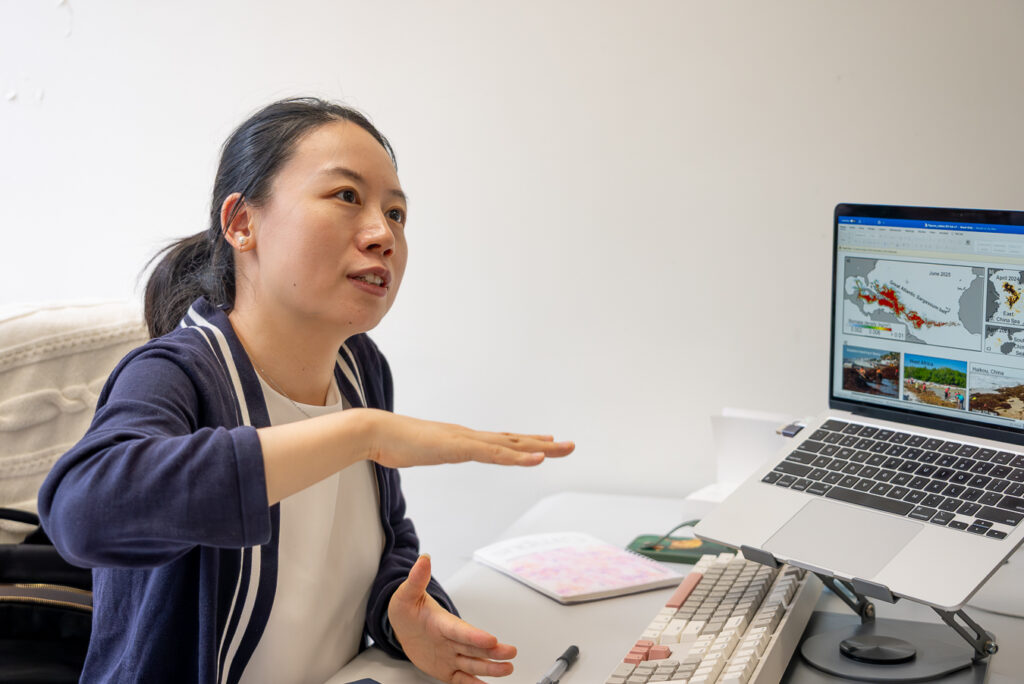
    The scale of Sargassum blooms can be hard to comprehend. To demonstrate what the planet is facing, Professor Wang pulls up a map showing the Great Atlantic Sargassum Belt, which stretches from the western coast of Africa across the ocean to the Caribbean and Mexico. 

    A recurring natural phenomenon, the Belt was observed as early as the late 15th century. “The ocean can benefit from Sargassum,” Professor Wang says, adding that they are “very big players in the ocean carbon cycle.” 

    Yet the Belt’s recent growth has worried researchers, as blooms set historical highs and landfall events in the Western Atlantic smother beaches and coastal wildlife.  

    “Satellites are an ‘eye in the sky,’ giving us a synoptic view of what’s happening below.” 

    – Professor Wang Mengqiu

    “In the open ocean, Sargassum acts as a carbon sink,” Professor Wang explains. “But if it reaches the coast, it releases hydrogen sulfide (a compound linked to asthma) and endangers coastal vegetation, including corals and seagrasses.” 

    Step one in addressing the problem is figuring out just how large the Belt has become – and where and when landfall events are likely to occur. But how do you measure something that spans an entire ocean? 

    Professor Wang shows the scale of the Great Atlantic Sargassum Belt
    Professor Wang shows the scale of the Great Atlantic Sargassum Belt

    AI in the sky 

    Typically, tracking Sargassum blooms might involve observations from a boat.  

    Both of these methods are expensive and time-consuming. So researchers like Professor Wang are turning to satellite and remote sensing technology, leveraging tools like AI and big data to quickly and efficiently identify Sargassum patches and map their locations. 

    Using satellites designed to monitor colour changes in the ocean, scientists can get a much better idea of how big the Belt – actually a thousands-of-miles-long stretch of discrete blooms – really is.  

    Although the underlying technology has been around since the 1980s, the field has benefitted in recent years from new hyperspectral sensors, higher-resolution images, and the shift from machine learning to deep learning. 

    “We don’t want to just react, we need to be able to make predictions.” 

    – Professor Wang Mengqiu

    The launch of NASA’s Plankton, Aerosol, Cloud, ocean Ecosystem (PACE) Satellite in 2024 was particularly exciting, Professor Wang says. “The satellite is a game changer because it’s hyperspectral,” she explains. “It will give us a much finer, more detailed knowledge of global changes.” 

    Previously, that level of detail would have been hard to analyse. But new deep learning techniques are making even hyperspectral imaging analysis possible, Professor Wang says. Her own work is one reason why: She just published a paper showing how to automatically de-noise images to better monitor algal blooms.  

    These advances will ultimately make it easier for scientists to predict the size and impact of future blooms, allowing for better management and mitigation. 

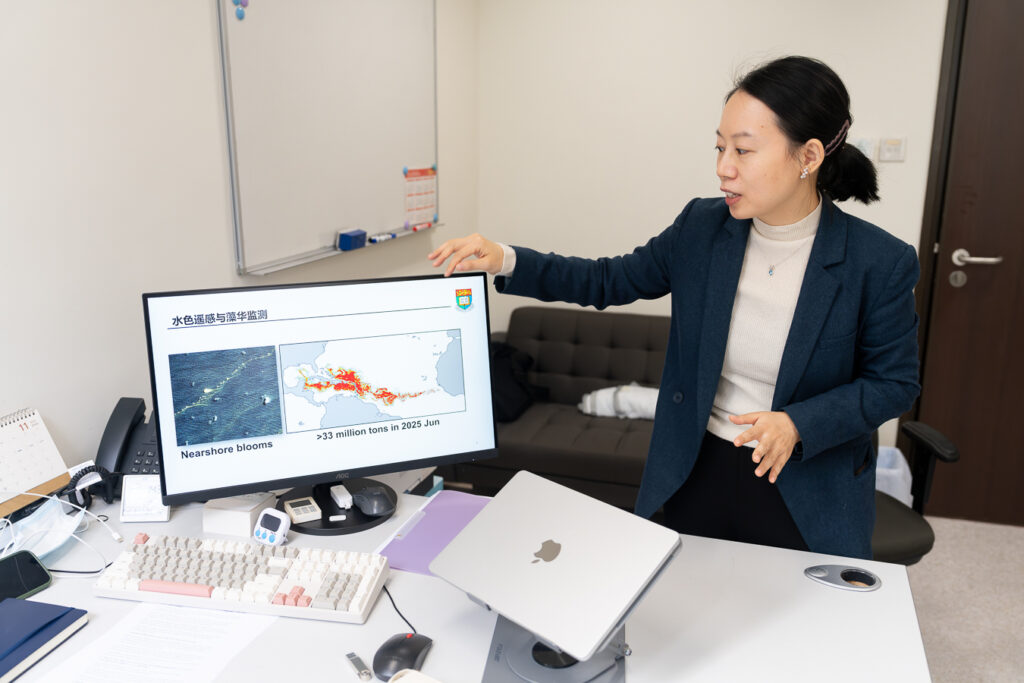
    Professor Wang explains her work using AI to track algal blooms
    Professor Wang explains her work using AI to track algal blooms

    The search for solutions 

    Professor Wang’s next project is to develop algal bloom distribution maps that can be used to guide policymaking. 

    The Atlantic isn’t the only ocean facing growing problems related to Sargassum. In the Yellow Sea and East China Sea, for instance, blooms have caused havoc in recent years.  

    Professor Wang hopes to work together with the Hong Kong government to understand public needs and design real-world applications for researchers’ growing trove of remote sensing data, including alarm systems for Sargassum landfall. 

    “The goal is to convert Sargassum into something useful: energy, building materials, or other applications.” 

    – Professor Wang Mengqiu

    While these ideas are still a long way off, she believes they could one day help mitigate or even eliminate the damage done by Sargassum to coastal ecosystems like Hong Kong’s – and even help vulnerable populations like the city’s fishers. 

    “I want to convert satellite products into something broadly useful,” she says. “As scientists, we have to serve the community.” 

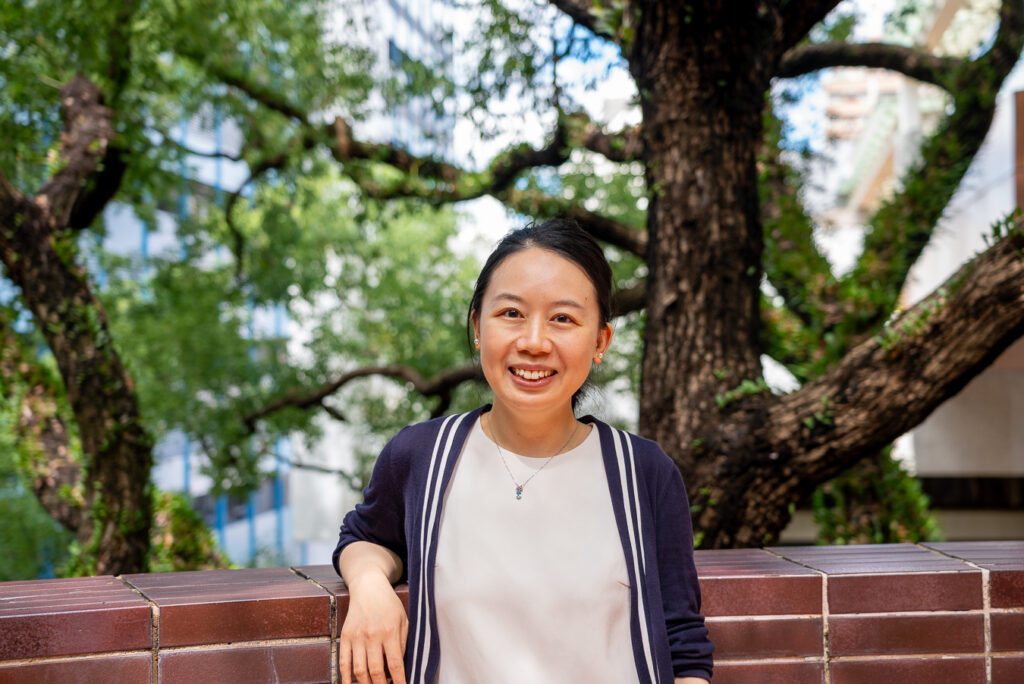
    Professor Wang poses on the HKU campus
    Professor Wang poses on the HKU campus
  • Jin Wu Wants the World to See the Forest for the Trees

    Jin Wu Wants the World to See the Forest for the Trees

    When most people look at a forest, they see an example of nature at its best, a planetary lung that is one of our most reliable defences against climate change. But University of Hong Kong Professor Jin Wu sees something else: a delicately balanced ecosystem that, if not properly managed, could play havoc with earth’s future.

    That’s because not all forests are created equal. The Amazon, for example, was traditionally dominated by evergreen trees. More recently, however, a mix of environmental changes, drought, and human encroachment have led many of these to die off and be replaced by deciduous variants.

    While it’s too early to say how this will impact the climate, the end result could be a vicious cycle, Professor Wu says. As temperatures rise, trees need more water to sustain themselves. If the water runs low, more evergreens die and are replaced by deciduous trees, which do not transmit water from the soil to the air as efficiently. That means less rainfall and even more evergreen loss, releasing their stored carbon into the atmosphere as part of a process scientists call “Amazon dieback.”

    “People think of forests as a way to fight climate change, but they can also facilitate climate change.”

    – Professor Jin Wu

    All is not lost, however. Professor Wu and his team are among the many scientists working to understand and track changes underway in the Amazon, in his case, through satellite data and remote sensing. “Remote sensing lets us scale up the knowledge we have of individual leaves and plants to a global level,” Professor Wu says with a characteristic smile. “Then we can turn that global knowledge into science-based decision-making.”

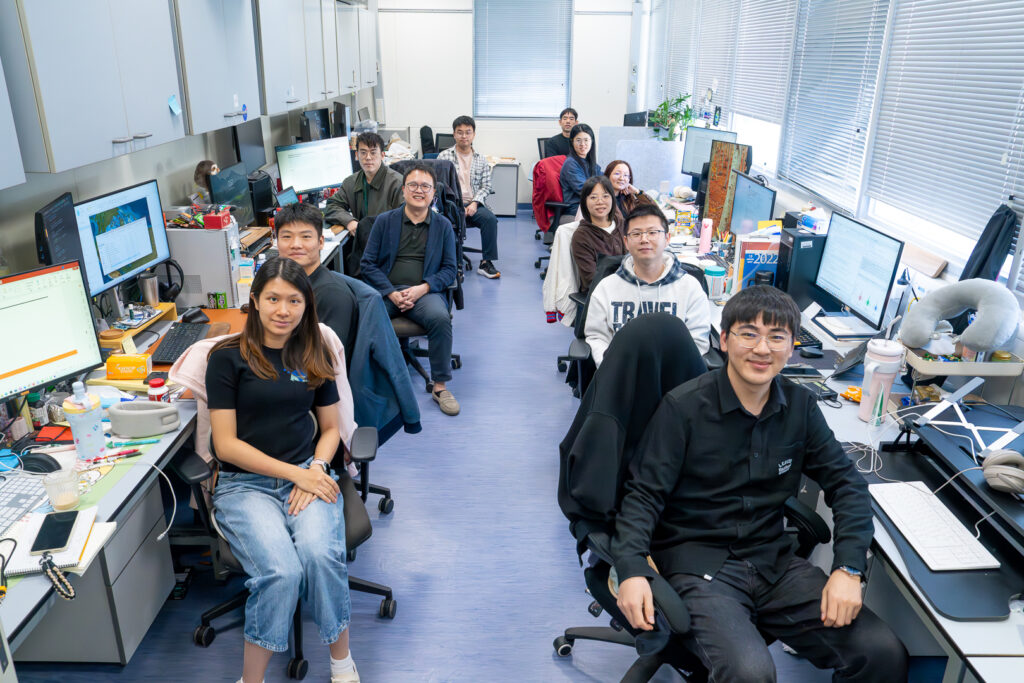
    Professor Wu poses with his students in his lab
    Professor Wu poses with his students in his lab

    From tree to forest

    The field of remote sensing is developing quickly, thanks in large part to new tools like machine learning and AI algorithms, Professor Wu says. One of the most exciting developments his team is working on is using satellite data to track the chemical fingerprint of individual plants, offering an unprecedented window into forest composition.

    The idea comes from a 2009 study by ecologist Dr Greg Asner, who figured out how to identify individual plant species based on the chemical compositions of nitrogen and phosphorus. Because these plant chemical traits interact with light in different ways, satellite imagery could theoretically allow scientists to identify the functional composition of an entire forest.

    “Plants all have unique chemical fingerprints, and remote sensing plus AI can help us identify them.”

    – Professor Jin Wu

    The key hurdle is data. Commonly used hyperspectral imaging techniques are prohibitively expensive and time-consuming. A few years ago, generating a hyperspectral image for a 300-by-300-meter plot cost around HK$20,000.  

    In search of an alternative, Professor Wu’s team turned to a multispectral approach. By looking at 10 criteria across dense image time-series within a year – as opposed to the over 100 needed for hyperspectral imaging – they believe they can develop a complete picture of plant coverage and the underlying high-dimensional chemical compositions around the world at a fraction of the cost. 

    If it works, it could allow scientists to track how plant species are changing across both space and time. And that knowledge, Professor Wu says, might prove vital in the fight against climate change.

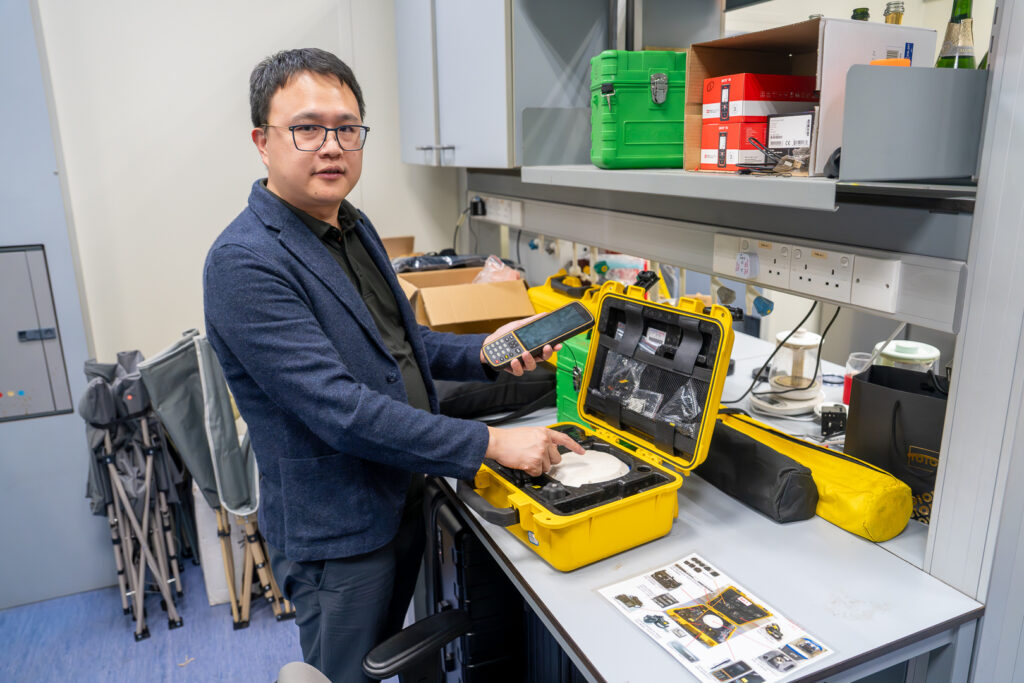
    Professor Jin Wu shows off some of the equipment he uses to monitor changes in forests.
    Professor Jin Wu shows off some of the equipment he uses to monitor changes in forests.

    Shrubs and CPUs

    Professor Wu and his team aren’t just looking at the Amazon. They’ve also trained a machine learning model to identify shrubs in the Inner Mongolian grassland. Long-term, they plan to map vegetation across the steppe, keeping an eye on this important ecosystem.

    Crucially, because their data is compatible with long-running databases, they can also look backward in time, allowing them to study the changes that have already taken place over the past 30 years. 

    “The field is evolving very quickly, and a lot of things we’ve never even dreamed of will soon be possible.”

    – Professor Jin Wu

    AI has helped make this possible, Professor Wu says, but the computational power needed represents a strain on the resources of smaller labs. Ideally, AI resources could be centralised so they benefit multiple teams at once – what he calls a “centralise and service” approach.

    Science with a smile

    Despite the challenges, Professor Wu remains optimistic about the future of remote sensing.

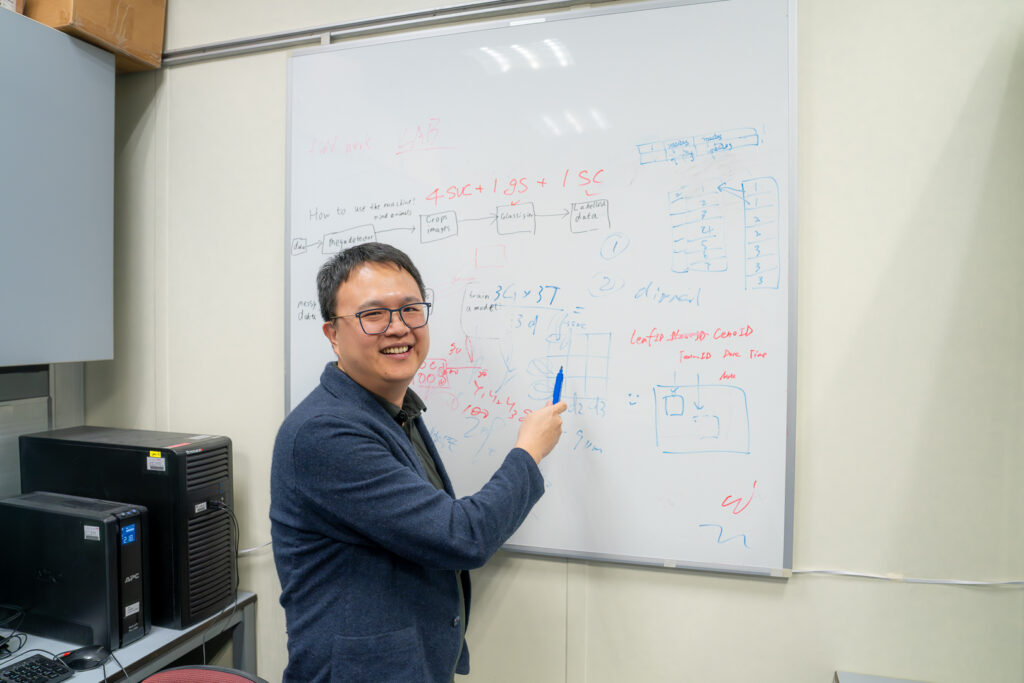
    His sunny attitude toward the sometimes slow speed of research progress is reflected not just in his near constant smile, but also in the list of advice for new PhD students on his office whiteboard, which includes both old saws like “be patient” and reminders to “be generous to yourself” and to not think of yourself as purely a helper. 

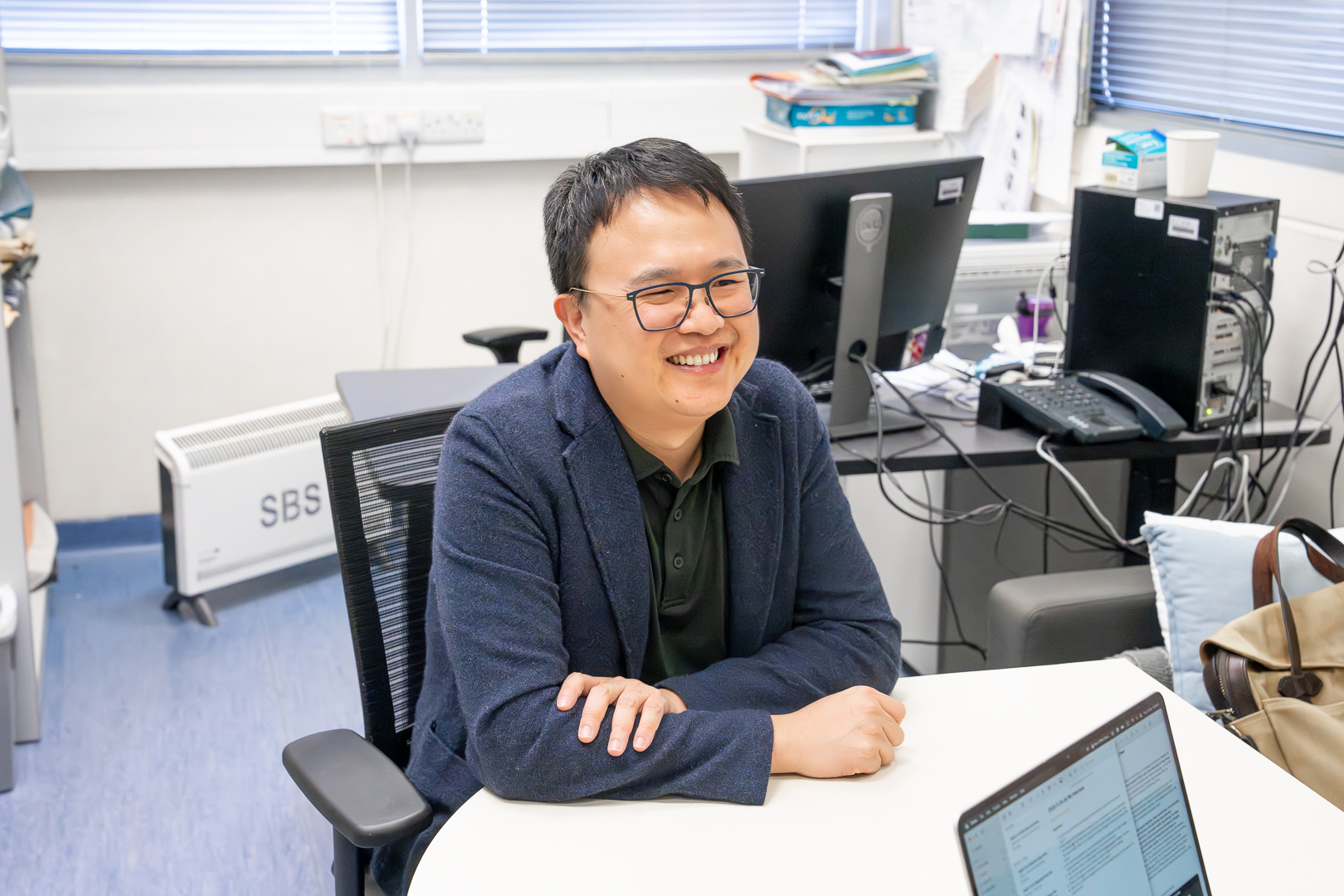
    Professor Wu stands in front of a whiteboard
    Professor Wu almost always has a smile on his face, even when explaining complex science.

    There’s also an item on there about the importance of the spirit of “discovery,” rather than just safely trying to refine existing methods. It’s advice he appears to have taken to heart, as even the mere mention of remote sensing’s prospects in the coming decades causes him to wax excitedly about new mechanisms and techniques that could revolutionise our understanding of the planet. 

    “This is an important field for the 21st century, and we’re well placed to connect science and policy,” he says. “I just hope the University of Hong Kong can leverage this curve and pioneer novel research.”

  • Reimagining the Future of Work with the Centre for AI Management and Organization

    Reimagining the Future of Work with the Centre for AI Management and Organization

    “My hope is that when people think about issues like AI and organisation, they think about CAMO.” 
    — Professor Jin Li

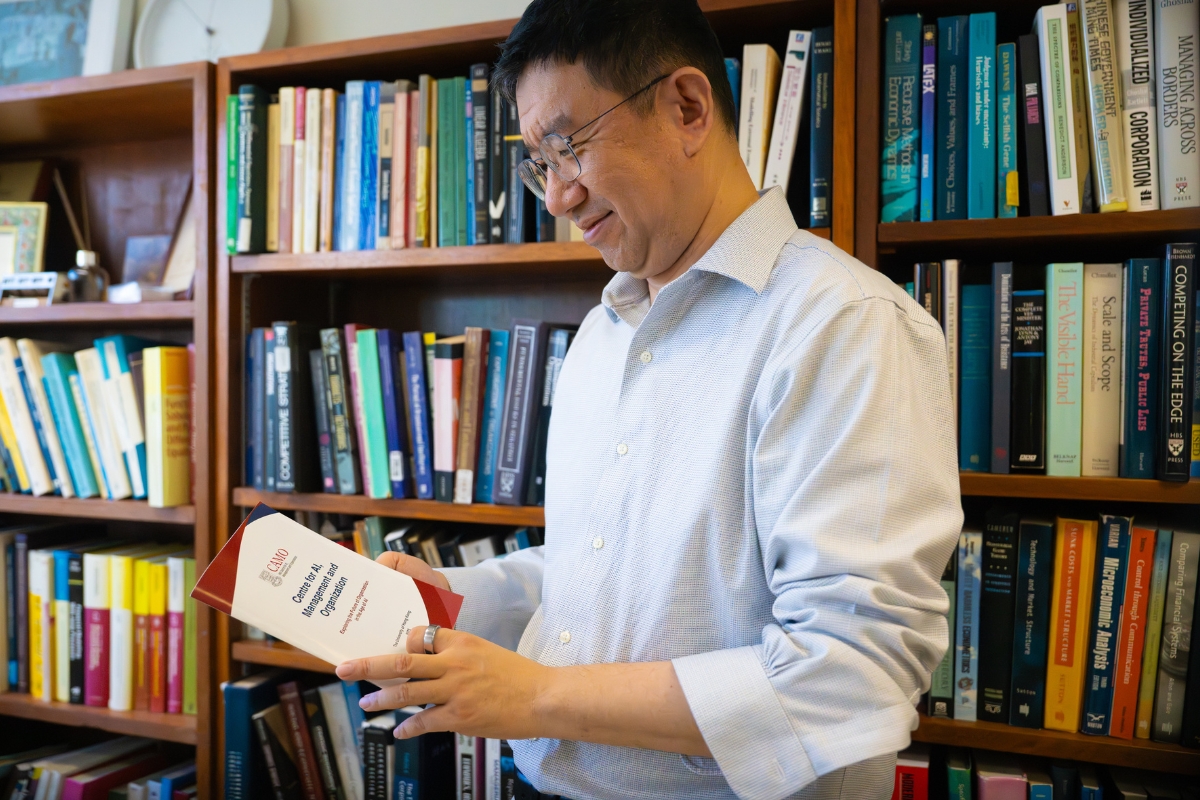
    When Professor Jin Li launched the Centre for AI, Management, and Organization (CAMO) earlier this year, his immediate goal was filling a gap in the scholarship on artificial intelligence and its impact on the future of work.  

    But Professor Li’s long-term vision is even more ambitious: Transforming the University of Hong Kong into a global leader in AI, Management, and Organisation research, positioning it at the forefront of a revolution that will shape the next half-century of work and corporate governance. In his own words, he hopes the centre will contribute the “grand ideas” and frameworks societies need to navigate the AI transition.  

    Drawing on the combined expertise of faculty from across the university – plus a board of advisers featuring members from the University of California, Berkeley, Columbia, the Massachusetts Institute of Technology, the University of Tokyo, and the London School of Economics – CAMO is well on its way to reaching that lofty goal. We asked Professor Li about what drew him to AI, how artificial intelligence is changing the future of work, and what’s next for CAMO.  

    The Pursuit of Happiness 

    When Professor Li was a young student growing up in Shanghai, his school emphasised that the “purpose of life is the search for excellence.” A top student at one of Shanghai’s best schools, Professor Li’s only weak subject was chemistry. The harder he worked and the more he struggled, the more he began to wonder whether there was more to life than excellence – that perhaps the real purpose of life was the search for happiness. 

    He found his answer in an introductory economics class at the California Institute of Technology (CalTech). As his professor explained that individuals maximise utility, he remembers thinking that this seemed an awful lot like maximising happiness. 

    “Now is the best time to study AI.” 
    — Professor Jin Li

    Although not directly involved in AI research at the time, a number of his friends and classmates would go on to play pivotal roles in an earlier wave of the AI revolution, and their work sparked his own interest in the field. Now, as he enters what he calls the “second curve” of life, he sees AI research as both important and a way to pursue a topic that has always interested him. 

    Out of the ‘Stone Age’

    Professor Li is fond of a famous line from Edward O. Wilson, in which the American biologist notes that we live in a world of “Palaeolithic emotions, medieval institutions… and god-like technology.” He envisions CAMO as contributing to the upgrading of those institutions to keep pace with technological change.  

    As an example, he points to the way many firms have struggled to update corporate governance and workplace norms for the AI age. Previously, the ideal firm was mid-sized: big enough to achieve economies of scale, but not so big that it becomes bogged down by bureaucracy – an example of what economists call the “U-shaped” relationship between size and efficiency. 

    “As economists, as management strategy scholars, we don’t have that much to do with technology. We cannot change human nature either. What we can do is to think about new organisations, new institutions.” 
    — Professor Jin Li

    Now, however, the AI boom has helped fuel the rise of both unicorns and tech giants like FAANG (Facebook, Apple, Amazon, Netflix, and Google). That tectonic shift has caught many companies off-guard, with CEOs and even consultants unsure of how to adapt. “Firms need to have a playbook,” says Professor Li. “They need to have a framework for how to move forward.” 

    The Future of Work 

    To help write that playbook, CAMO has already surveyed more than 100 C-suite leaders and 500 HR reps as it works on a practical guide for companies navigating the AI transition.  

    One of the centre’s current points of emphasis is identifying the jobs humans don’t want to do, helping firms to decide on automation priorities without exacerbating popular fears of AI “replacing” workers. This approach is also what sets CAMO apart. “There are very few centres that focus on organisation,” Li says. “It may sound cocky, but I don’t think there are more than three to five institutions in the world with the same calibre of people as us.” 

    In addition to laying the “intellectual foundation” for the study of AI and the future of work through his research at the centre, Professor Li is also hard at work on a new book about “The Great Compression.”  

    “I like to call incentive and knowledge the ‘yin’ and ‘yang’ of AI.” 
    — Professor Jin Li

    The access to knowledge promised by AI has spawned new incentives – to cheat, to game the system, to “shirk” – all of which managers must understand and learn to spot. Professor Li’s book will explore these two sides of AI, as well as their combination, which he identifies as “power.” In the process, he hopes to help managers better navigate both the opportunities and risks of the AI era. 

    If all that seems daunting, Professor Li would likely agree. When asked about the biggest challenges he’s facing, he replies quickly: “Time.” There are so many interesting and exciting potential projects, he explains, but the CAMO team must be selective and focused in its priorities. “It’s such an exciting time that I’m not getting enough sleep,” he says with a wry smile. “But now we’re being bombarded with so many interesting possibilities.”