
Brute-force computation cannot solve these difficult problems – because of the exponential wall, one has to approach them with deeper understanding: either applying artificial intelligence or human intelligence. Now with AI, many of the previously impossible simulations – because they required vast amounts of computational power – are becoming possible.
Professor Ziyang Meng is an acclaimed computational condensed matter physicist and is one of the pioneers of the use of AI in computational physics. His research focuses on developing large-scale numerical and machine-learning simulations to investigate quantum materials. Professor Meng has published more than 100 papers in top journals such as Nature, Nature Physics and PNAS. In this interview with our science editor, Dr Pavel Toropov, Professor Meng explains how AI has revolutionised quantum and computational physics research. He also talks about ancient Greece and mahjong.
❓ Dr Pavel Toropov: How do you use AI in your work?
💬 Professor Ziyang Meng: Quantum materials are very complicated. The existing methods usually face an exponential wall.
(Note: in a quantum system, each particle can exist in multiple states. As the number of particles increases, the number of possible states increases exponentially, and thus so does the amount of information needed to describe the system and the computational capacity to do so. This increase is known as the exponential wall.)
The wall is very high! Our computational capacity cannot jump over it. So, we use AI to extract quantum information in a quantum material. This information is used to design better algorithms that help us jump over an exponential wall to look into new materials, new properties.
For example, we developed what is called the Self-Learning Monte Carlo Method. It is one of the first examples of employing explainable-AI techniques in quantum many-body systems. It helps to open up the field of AI-inspired algorithms for reducing numerical complexity in the computational research of quantum materials.
My inspiration for developing these AI-related algorithms comes from the (ancient) Greek Delphic maxim “know thyself”.
❓ This is a lot of terminology! Before we get to the ancient Greece part, could you explain why quantum materials are complicated?
💬 The basic ingredients of quantum materials – electrons, billions and billions of them, are subject to mutual quantum mechanical interactions and the complicated chemical, physical and topological environment they live in.
The full quantum treatment of so many electrons is way beyond paper and pencil. Instead, it requires modern computational techniques and advanced theoretical analyses.
Brute-force computation cannot solve these difficult problems – because of the exponential wall, one has to approach them with deeper understanding: either applying artificial intelligence or human intelligence. Now with AI, many of the previously impossible simulations – because they required vast amounts of computational power – are becoming possible.
❓ Can you give an example?
💬 The Self-Learning Monte Carlo algorithm. With this algorithm, we first use AI to extract better model parameters at a smaller scale – with few electrons, simulation, and these parameters can more accurately present how the billions of electrons interact with each other inside the material, and how they respond to the experimental conditions such as temperature, electronic or magnetic fields.
(Note: Monte Carlo simulation allows us to model and solve problems that involve randomness and big data. It is used to handle such situations by testing many possible scenarios.)
Then we can start the large-scale Quantum Monte Carlo simulation on supercomputers. It is faster than the tradition simulation without the self-learning step that involves AI.
The self-learning step is crucial. It gives us better and more accurate model parameters, which means that we get to know the properties of the material better. This is what I meant by the Delphic maxim “know thyself”.
To “Know yourself” means that we must find the most important interactions among these interacting electrons. Self-learning, therefore, is as modern as AI and quantum physics, but also as old as the beginning of human civilisation – ancient Greece.
❓ Do you mean the Delphic maxims – the set of moral principles that were inscribed on the Temple of Apollo in ancient Greece?
💬 Yes, and I even wrote a popular science article about this – “From Delphic Oracle to Self-Learning Monte Carlo”. The article is in Chinese and was published in Physics – a journal of the Chinese Physics Society. http://www.wuli.ac.cn/cn/article/doi/10.7693/wl20170406).
❓ So, AI speeds things up by saving quantum physicists a lot of number crunching?
💬 AI in quantum physics research does not only mean that we can compute faster. AI helps us find better, more accurate, models for the quantum materials. This allows us to better understand the material and also better understand the process of understanding: that’s how we can come across new laws of physics.
❓ Quantum physics is not something that most people experience in their daily lives. To non-specialists, such research may sound very abstract, entirely theoretical. What does your research mean in the “real world”? What are the practical applications of your work?
💬 Our Momentum-Space Monte Carlo self-learning method deals with a new mystery in a quantum material: the magic angle twisted bilayer graphene in which superconductivity has been recently discovered. Graphene is what we have in every pencil! If we can elevate the superconducting temperature from minus 270 Celsius to, say, room temperature, we can solve the global energy crisis.
Our recent paper on this was awarded the 2024 Top China Cited Paper Award for Physics.
❓ How can this solve the energy crisis?
💬 Using superconductor cables and wires, the electricity, once generated from the power station, will not be lost as heat and dissipate into the air. This is because the electrons in the superconducting state will not experience resistivity as in commonly used conductors such as copper, iron and any other metals. Not experiencing resistivity means electron movement will not be slowed down, converted into heat and lost, and 100% of the generated energy can be used for the intended purpose.
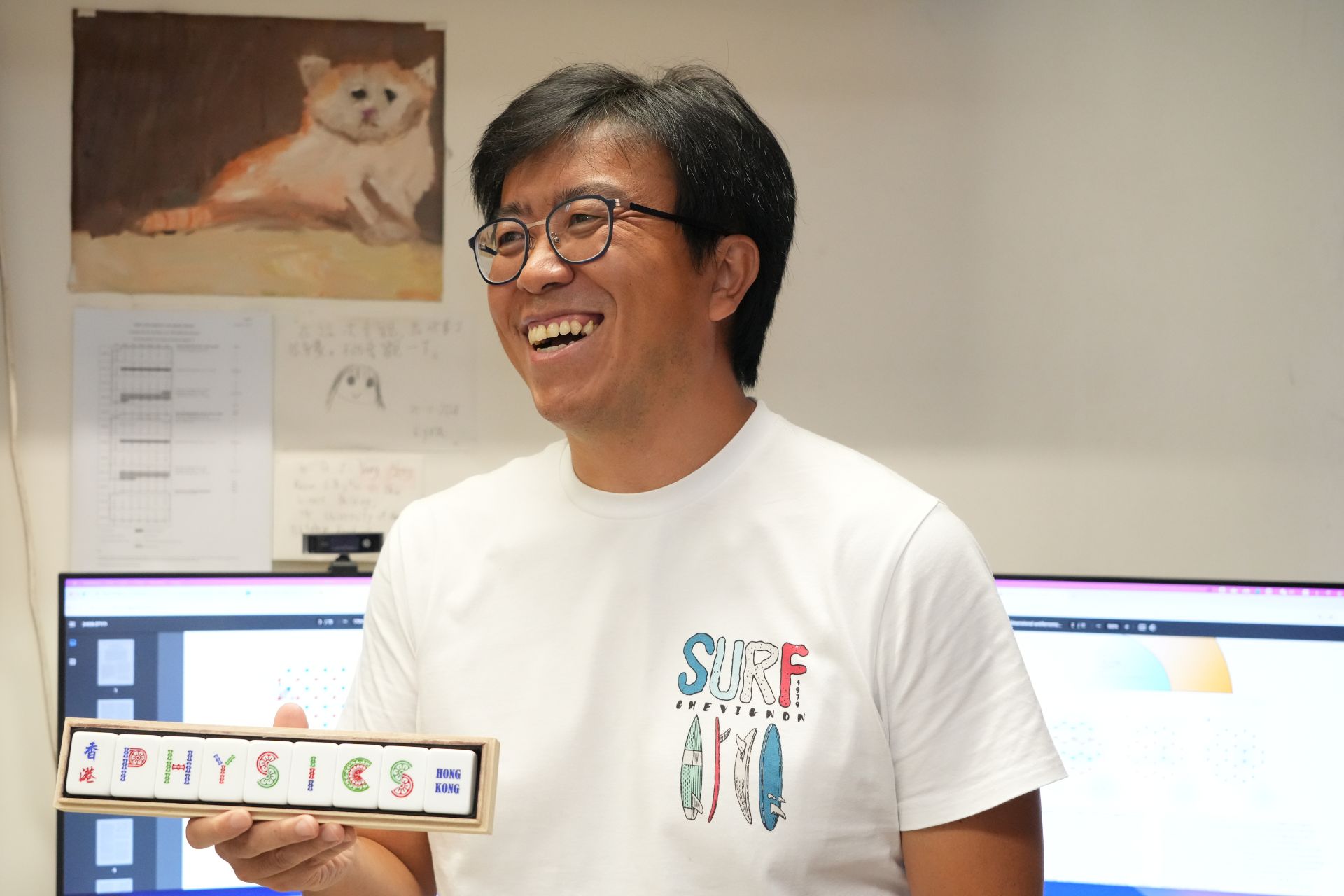
❓ In your office you have a physics-themed mahjong set. Why?
💬 Mahjong is a strategy game. In quantum physics, AI helps the physicist with strategy, allowing the physicist to better understand the problem. I find AI to be a very good partner who helps the physicist solve the mysteries of Mother Nature.
Mother Nature plays games with us, hiding her secrets behind complicated phenomena, and we need a good partner – like AI, to play this game, and find solutions.
I am teaching a new undergraduate course at the HKU Physics Department – PHYS3151: Machine Learning in Physics, where you can learn how to use AI techniques to solve problems – from Newtonian mechanics and electromagnetism to quantum phenomena. Everyone is welcome to join!
https://quantummc.xyz/hku-phys3151-machine-learning-in-physics-2024/
👏 Thank you, Professor Meng!