We use AI to decode bacteria’s chemical language. Genome information is now available online – more than one million bacterial genomes are available!
We developed a new methodology called genome mining. AI looks at a million genomes and assesses their genetic potential for coding an antibiotic or an anti-viral molecule.
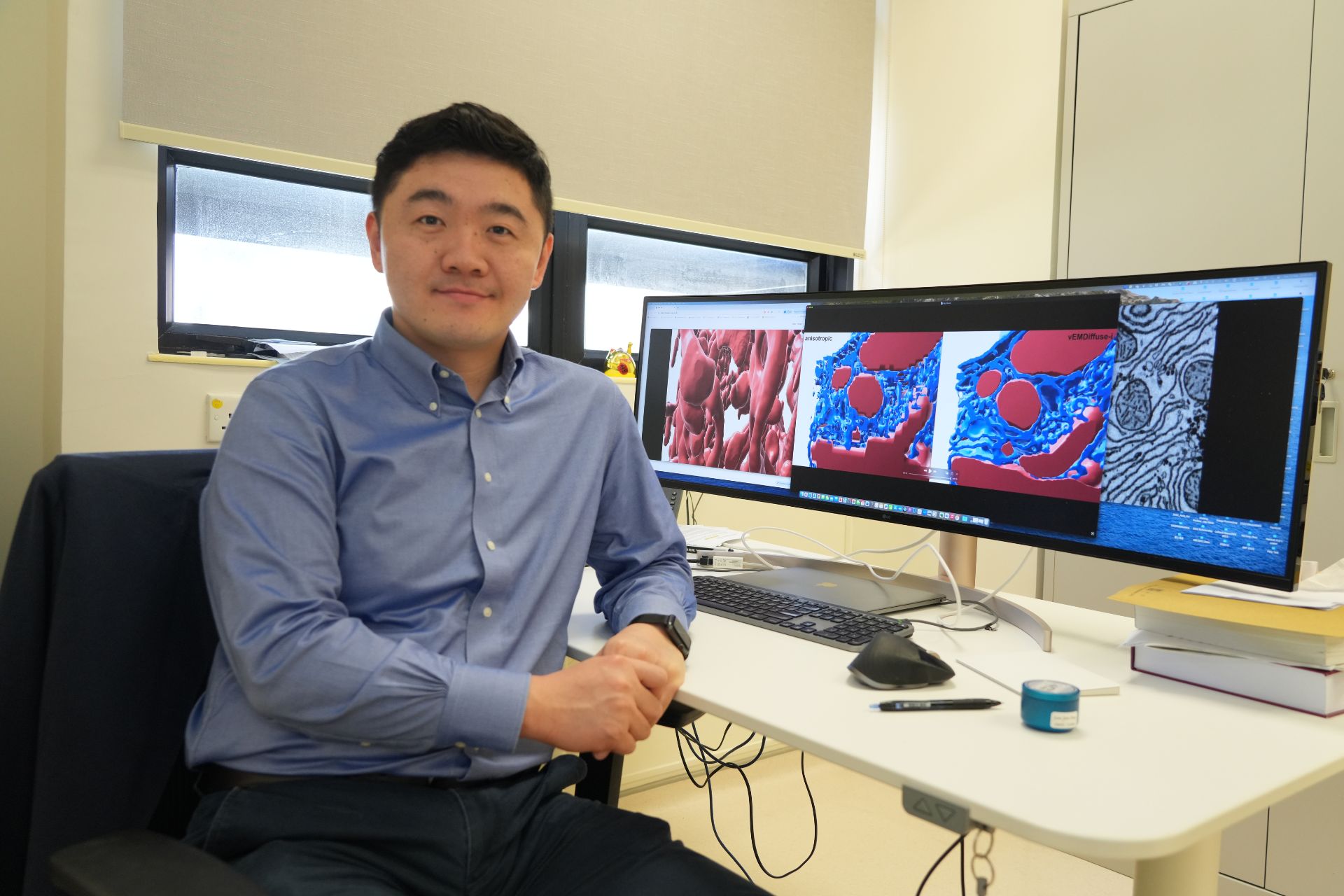
Professor Philip Yongxin Li, from the Department of Chemistry, specialises in chemical biology and drug discovery, with the focus on bioinformatics-guided drug discovery and biosynthesis. In this interview with our science editor, Dr Pavel Toropov, Professor Li talks about how his team uses AI to create new antibiotics.
❓ Dr Pavel Toropov: Could you explain your research?
💬 Professor Yongxin Li: We work on discovering new antibiotics to tackle the problem of antibiotic resistance – superbugs. Because of on-going overuse, the current antibiotics are failing, and superbugs – antibiotic-resistant bacteria – are emerging.
My job is to learn from Mother Nature. In the natural environment, bacteria use chemicals as weapons, used in competition with other bacteria. These are very intense chemical interactions!
Our job is to decode this chemical language, make good use of bacteria’s chemical weapons, repurpose them for therapy, and develop them into antibiotics and anti-virals to kill human pathogens.
But rather than following the traditional way – culturing bacteria, isolating them and identifying chemical compounds that they make, which is time- and labor-consuming – we look at the genetic potential of bacteria, mining the chemicals from bacterial genomes from large datasets.
Instead of using synthetic chemistry to make new antibiotics, we use synthetic biology to harness their genetic potential for drug discovery. We use cell factories, cell assembly lines to produce chemicals for us. We clone biosynthetic genes [Note: biosynthetic genes are genes that produce complex chemicals, such as those used to kill other bacteria], plug them into a cell’s factory, and let the cell factory build the antibiotic for us.
❓ How is AI used in your work?
💬 We use AI to decode bacteria’s chemical language. Genome information is now available online – more than one million bacterial genomes are available!
We developed a new methodology called genome mining. AI looks at a million genomes and assesses their genetic potential for coding an antibiotic or an anti-viral molecule.
💬 The traditional methods analyse the genomes one by one. It is not efficient, and the chance of discovering a new antibiotic is low. So, we train AI to select, from one million genomes that can contain 20 or 30 million biosynthetic genes, the genes that code for antibiotics.
We use AI to select and prioritise the genes with the highest probability that they code for new antibiotics. Using AI we can also predict the antibiotics’ structure and bioactive potential.
❓ How much time does AI save?
💬 Using the traditional way, the in-silico screening process [Note: “in silico” means biological experiments conducted on a computer, or via a computer simulation, to make predictions about the behavior of different compounds] can screen several thousand biosynthetic genes and narrow them to about 100 for experimental validation. Using AI, we can start with 20 or 30 million genes and evaluate their potential for coding for antibiotics.
The traditional way can take years. But, using AI, we can finish assay in silica within a few days and even hours. To validate the result, you still need to clone the gene, so we need to use synthetic biology and this part still takes a long time.
❓ How close are you to creating a new antibiotic?
💬 Drug discovery and drug development are a very long process. But with one of our lead compounds, we have finished pre-clinical tests, anti-infection application in vivo, and evaluated ecotoxicity. It is ready for the next step.
👏 Thank you, Professor Li.