
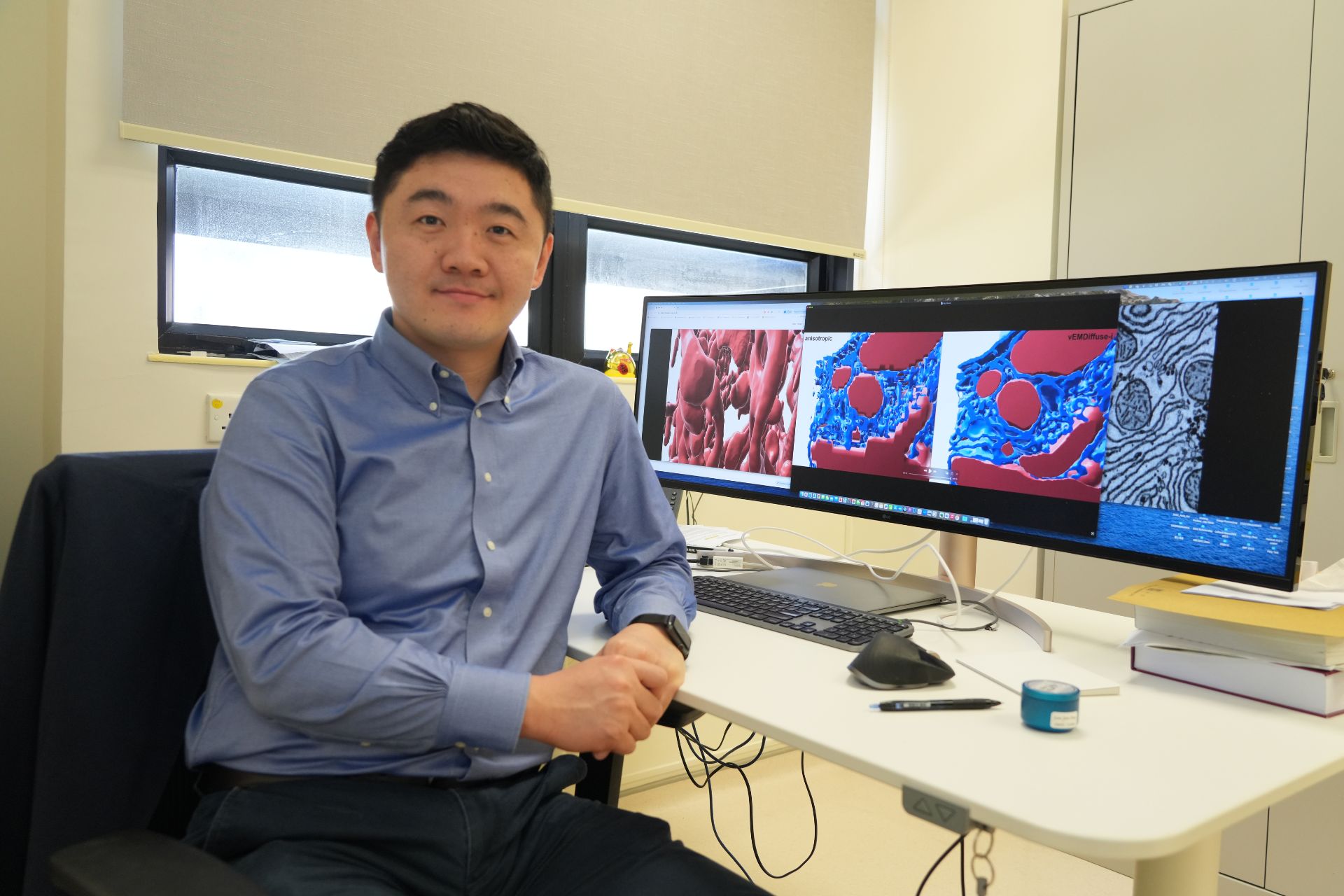
Professor Haibo Jiang works at the Department of Chemistry at the University of Hong Kong and is the director of the multi-disciplinary JC STEM Lab of Molecular Imaging. He received his PhD from the University of Oxford and joined HKU in 2021. In this interview with our science editor Dr Pavel Toropov, Professor Jiang explains the importance of AI in his research.
❓ Dr Pavel Toropov: what is the research focus of your lab?
💬 Professor Haibo Jiang: My lab focuses on the development of new imaging technologies to see inside biological systems at a very small scale. For example, what is happening inside a single cell or a single organelle.
Our molecular imaging combines different modalities of microscopy – optical, electron and mass spectroscopy imaging. By combining them we can extract information from one sample so that we can understand what is happening in its biology and structure.
❓ What are the images used for?
💬 One example is tracking, with high resolution and very high sensitivity, of drugs in biological systems. We can see when people (and we also use animal models) take the drug, where the drug goes, and how it gets to the target to be therapeutically effective.
We combine structural information from electron microscopy with chemistry information from mass spectrometry imaging, and then we can then reliably correlate where the drug is – in which organelle, in which cell, in which tissue of which organ. We can also learn why the drug is, or isn’t, effective, and why it causes side-effects.
❓ Which drugs are you working with?
💬 Our system is versatile. We have applied it to understand the traffic of antibiotics. Once in the human body, antibiotics need to get to the bacteria to kill them. We can track a range of different antibiotics to see if they get to the right cells at the infected site. We also applied our methods to study cancer drugs to see where the drug gets into the cell, because this is important for its efficacy.
❓ And what does the AI do?
💬 For us, AI makes the impossible possible! With AI we can achieve high image quality at high speed.
❓ Could you explain?
💬 The biggest problem in imaging is the compromise between image quality and image speed. AI speeds things up and also provides better resolution. Currently, the hardware we have has its limit in spatial resolution, so the improvement has to come from the software – which means AI.
One of the major limitations of our method is that it is slow. It is the nature of the microscopy techniques that we use. We scan pixel by pixel, and there is a compromise between the quality of the image and the speed of the imaging. If we scan fast, there will be noise and the signal would be low. If we scan one pixel ten times, we can get higher signal and less noise and the quality would be much higher, but it takes longer.
But using AI, we can improve the electron microscopy speed by more than 10 times, it is faster and more efficient. With AI, we can speed things up by using a lower resolution image, but at a faster rate, and cover a big region of the sample to extract more information from one biological sample.
❓ What is the next step for you?
💬 Life is in 3D, but what we just talked about is 2D. When we get to 3D imaging it is even more challenging!
There is a technique that allows you to look at 3D structures of cell organelles, but at most, you can do around 200 by 200 by 200 microns, and that’s really small for a tissue sample.
But scientists dream of seeing a big sample in 3D. For example how the neurones are connected in the human brain. This is not possible with the current technology. Our dream is to have algorithm technology to achieve high speed 3D imaging of large biological samples. We are not there yet, but that is our aim.
❓ What is the future of AI in your field?
💬 I think, in biological imaging, AI will be everywhere. From the imaging itself, to the data analysis. I only started collaborating with AI people after I came to HKU, but I think AI will be the future.
But AI will not replace what we, humans, do. We need to learn how to employ AI in our research – to do what we do, but better.