
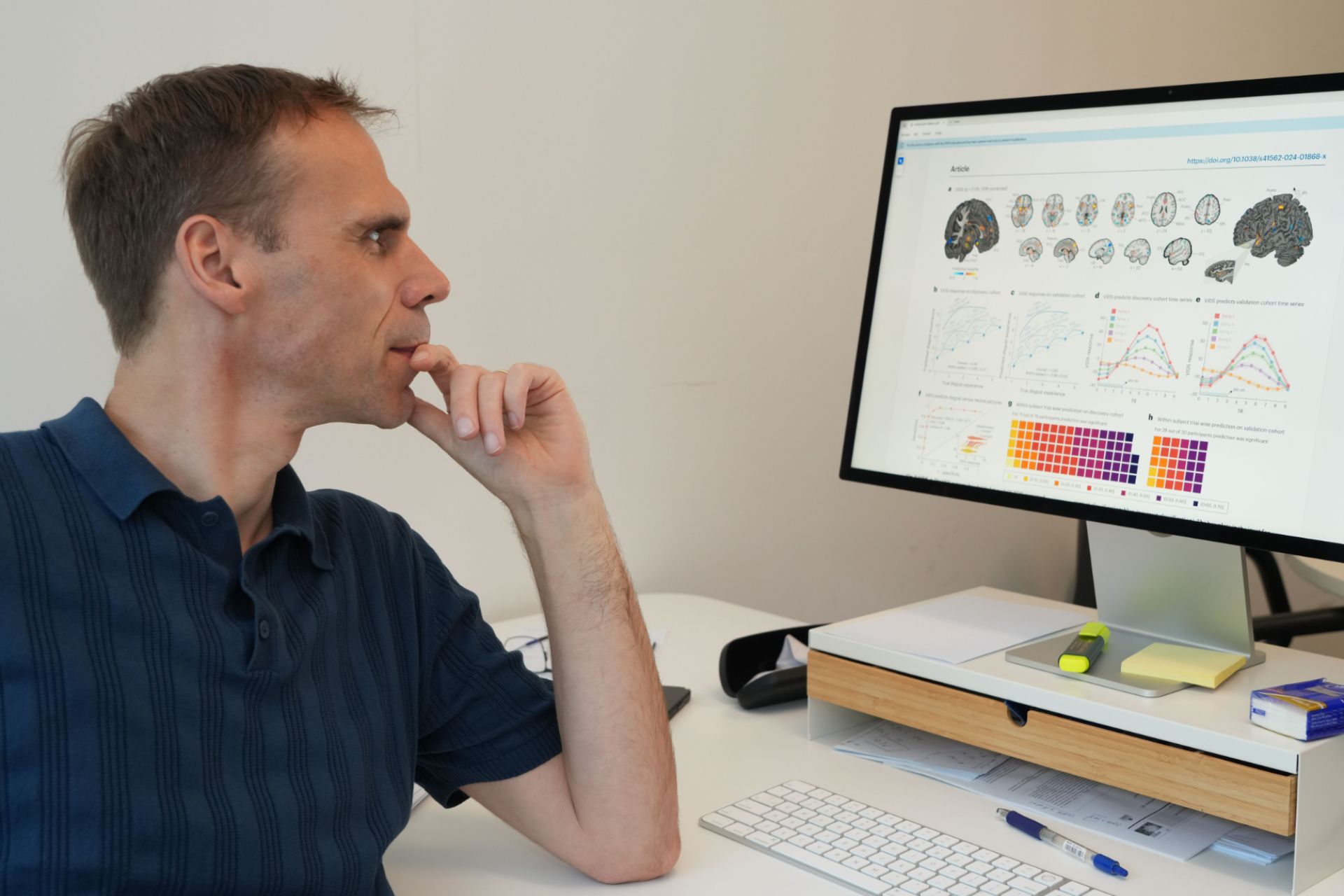
“AI can help us greatly in finding patterns in this data. We recently discovered that we can use AI inspired procedures to read emotions from the brain. AI can find out if someone feels afraid or feels disgusted, for example.” – Prof. Benjamin Becker
Professor Benjamin Becker studies the human brain. His innovative, cutting-edge research has been published in top journals such as Nature Human Behaviour and the American Journal of Psychiatry. In this interview with our science editor Dr Pavel Toropov, Professor Becker talks about the breakthroughs that Artificial Intelligence made possible.
❓ Dr Pavel Toropov: What is the main direction of your research?
💬 Professor Benjamin Becker: Trying to find out how the human brain generates emotions, and what happens with these processes in people with mental disorders and how we can make this better.
❓ How do you use AI?
💬 AI allows us to make very big progress in analyzing brain images. The brain is a highly complex structure, probably the most complex structure in the Universe. We are looking at the biological architecture of the brain made from billions of neurons with billions of connections. Humans, because our cognitive capacities are very limited, struggle to make sense of these very complex patterns.
AI can help us greatly in finding patterns in this data. We recently discovered that we can use AI inspired procedures to read emotions from the brain. AI can find out if someone feels afraid or feels disgusted, for example. Using human brain power this is nearly impossible. We need complex algorithms to help us make sense of this complex data.
❓ How is this done?
💬 We put individuals in MRI scanners to image their brain activity while we induce specific emotions. What we, humans, can only see (in the brain scan images) is that particular brain regions become active. But this is too simple, and AI allows us to see more complex patterns and read out the emotions that the individual experiences.
❓ Can you specify?
💬 We, humans, see that specific regions in the brain have become active, but these are rather big structures, and what AI can do is screen those structures on a much finer level than humans can, and then use the data to generate complex patterns – like the fingerprints that specific emotions have left on the brain.
Most amazingly, based on these patterns that it sees in the brain, the AI can read out what the person feels at a given moment. For humans this data is too noisy and too complex. A human interpretation is just not possible. AI gives us the cutting edge.
❓ So, for humans, basically, a brain scan is too noisy – blurry, messy, to see pattern in it. But AI can look at a series of such brain scans, see through this noise, and say – these are all the same, and these people are all feeling, say – fear?
💬 Yes. AI can even take advantage of this noise to make very good predictions.
❓ How cutting edge is this? This was not possible just a few years ago, right?
💬 Yes. I think there has been progress on three sides. Progress with imaging technology, MRI. Then we have progress in terms of what we know about human emotions, and the third is the progress in machine learning and AI.
❓ Where can this take us in the future?
💬 When MRI was developed 30 years ago, people said: in ten years we will have understood the entire brain. This did not happen. It was too optimistic. The brain is still the most complex structure in the Universe, so to understand it will still take some time.
I see more progress from AI in applications. In basic research we look at how emotions are processed in the brain, we look at mental disorders, because that’s when emotions dysregulate. Patients with depression, addiction, they have problems controlling their emotions and they feel these negative emotions very strongly.
Our hope is to map these emotions in a healthy brain, and then apply AI to support the diagnostics of mental disorders. We now see advances where AI can help make good diagnosis – for a medical doctor it is difficult to decide – does this patient have depression, anxiety or something else?
AI could provide us with a probability value – for example, 80%, that this patient will respond to this treatment and not to this one. We will be able to make huge progress, reducing the duration of patients’ suffering and also reducing the cost for the health care systems.
The second thing – using AI, you can have subgroups of patients and make better recommendations for their treatment.
❓ What do you mean by subgroups of patients?
💬 Working as part of a large collaboration, we have recently shown a lot of variation in the symptoms and brain alterations in adolescents with depression. Using findings like these we could target different brain areas, or provide different treatments (according to the subgroups). Some patients would, for example, respond better to behavioral therapy, others to medication, others to brain stimulations.
❓ Can this technology be used clinically, in the real world?
💬 What we see is that there is good progress, but right now AI is not precise enough for clinical diagnosis level. This is about human life. Perhaps soon we will be able to use AI to make recommendations, but now the predictions are not precise enough to enter clinical practice, we need to have a high level of certainty.
❓ There is a lot of fear about AI replacing humans in many jobs. Do you think that in the future AI can replace psychologists?
💬 I think in the next 10 years I will be able to get away with it! I am not concerned for psychology and I would recommend students who have an interest in psychology to pursue it.
❓ Why are you so confident?
💬 One area where AI will not overtake us is in understanding other humans, communicating with other humans, bringing humans together and treating humans as therapy.
❓ Is there a scientific basis to this?
💬 Yes. An area where we see more and more research is AI interaction with humans. We recently did a study about our trust in other humans and in AI.
From very early on in our lives, we are very sensitive to whom we can trust. Evolutionary this is very deep. If you don’t have this skill, your ancestors probably did not survive for long, because they trusted the wrong people or because they did not trust anyone.
We showed that there is a clear brain basis for our trust in other humans. At the same we assessed people’s trust in AI. We asked them – do you trust AI? We saw that these two “trusts” are not related! Moreover, trust in humans was associated with specific brain systems, but we did not see a brain basis for AI.
We have learned as species to trust each other. This is ingrained in our biology. But with AI, even though it is somehow human-like, it has only been there for a couple of years. How can we know whether to trust it or not?
👏 Thank you, Professor Becker.