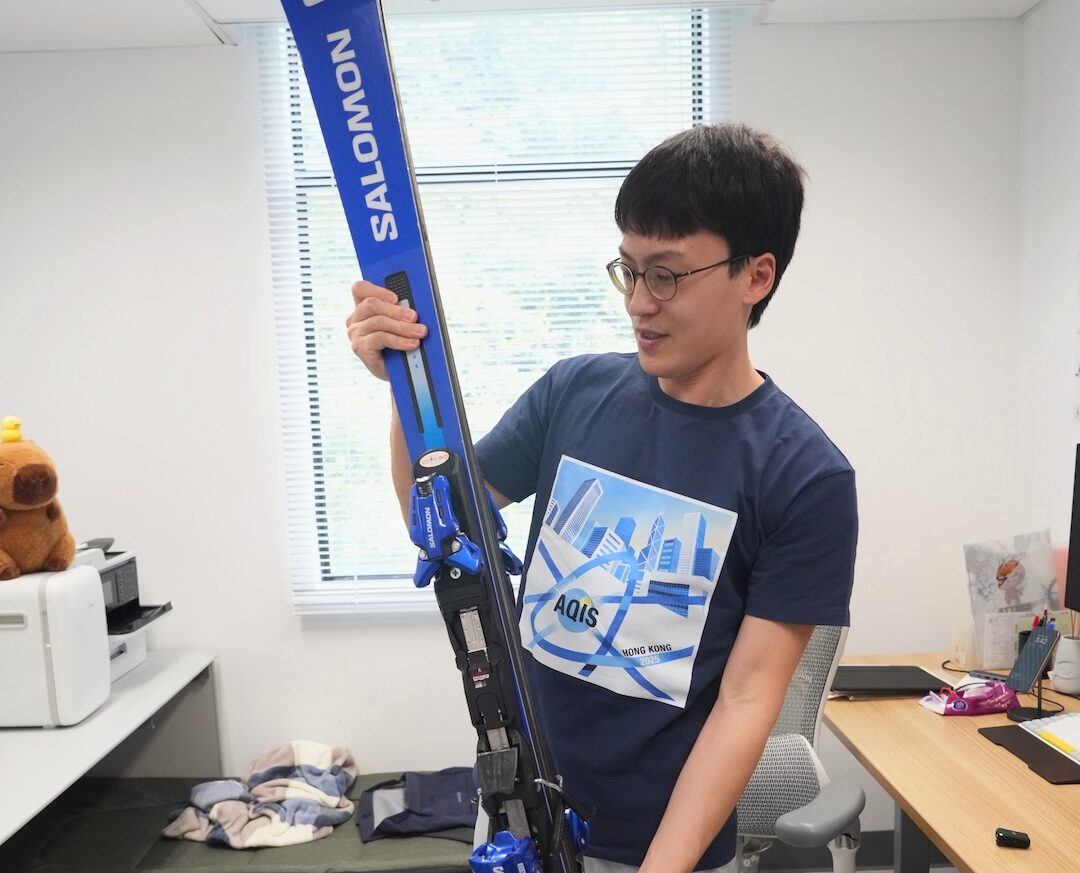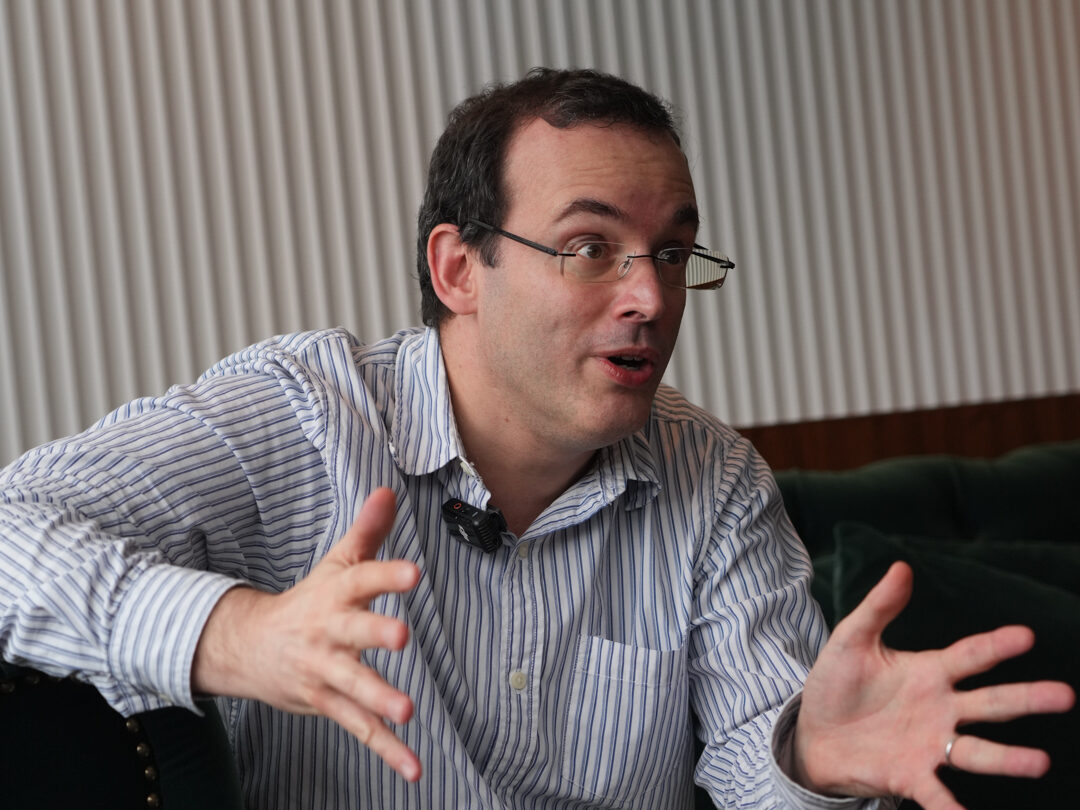
Tag: When Quantum Meets AI

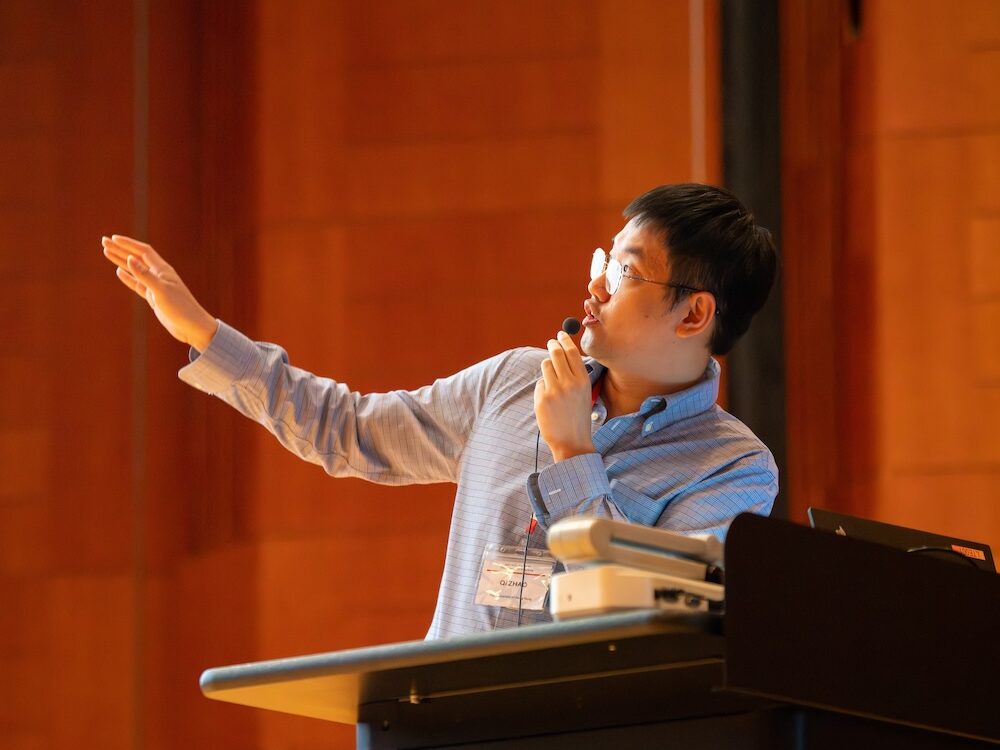
  • Teaching Machines to Think Quantumly: Qi Zhao on the Frontier of AI-Driven Computing

    Teaching Machines to Think Quantumly: Qi Zhao on the Frontier of AI-Driven Computing

    “Quantum computers don’t just calculate. They learn from the rules of nature itself.” — Prof. Qi Zhao

    Artificial intelligence is everywhere — in our phones, our cities, and the tools we use to think.

    But for Professor Qi Zhao at The University of Hong Kong’s School of Computing and Data Science (CDS), the next leap in AI may come from a place far smaller than any silicon chip.

    His research explores how quantum physics and machine learning can work together to create a new kind of intelligence — one that learns the way the universe learns.


    From Theory to Computation

    Zhao trained as a quantum information theorist, studying how data behaves when stored in particles rather than bits.
    At HKU CDS, he leads a group that builds hybrid computing models combining classical algorithms with quantum processors.

    His goal is simple to state but hard to achieve: use quantum systems to make AI faster, smarter, and more energy-efficient.

    “Classical computers follow fixed paths,” he explains. “Quantum computers can explore many paths at once. That difference changes how learning works.”


    Reimagining Computation

    Traditional AI trains neural networks through repetition — adjusting parameters until patterns emerge.
    Quantum computers take a different approach.

    They rely on variational quantum algorithms, where a small quantum circuit learns by tuning itself with help from a classical controller.

    Think of it as teamwork: the quantum part handles exploration; the classical part handles evaluation. Together, they solve problems that would take ordinary machines far longer to compute. Zhao’s team studies how this cooperation could transform optimization tasks, from image recognition to material design.


    Quantum Machine Learning in Action

    Inside his lab, AI helps control fragile quantum hardware.

    Algorithms adjust pulse shapes, timing, and temperature to keep qubits stable. The system learns which conditions produce reliable results and adapts automatically when the environment changes. “It’s feedback learning in the truest sense,” Zhao says. “The machine is teaching itself how to stay coherent.”

    These experiments do more than improve performance. They show how AI and quantum physics can enhance each other.
    AI stabilizes quantum devices; quantum mechanics gives AI new mathematical tools for creativity and pattern discovery.


    Learning from Quantum Data

    Zhao believes that the next revolution will come when AI no longer just analyzes quantum data — it learns inside quantum data.

    His group explores models where quantum systems perform the learning directly, finding relationships hidden from classical logic.
    Such systems might recognize molecular structures or financial correlations beyond human intuition.

    “This is where AI stops imitating intelligence,” he explains. “It begins to share it.”


    Mentorship and Collaboration at CDS

    As a mentor, Zhao encourages students to cross boundaries between physics and computer science.
    He collaborates closely with Prof. Giulio Chiribella, Prof. Yuxiang Yang, and Prof. Ravi Ramanathan, creating a bridge between theory, experiment, and data science.

    In class, he simplifies complex formulas into visual intuition. His students learn not only to code algorithms but also to think about why an algorithm works. “The most exciting discoveries,” he says, “often happen when we try to explain them simply.”


    Looking Ahead: The Shape of Quantum Intelligence

    Zhao imagines a future where AI systems powered by quantum hardware design drugs, manage energy grids, or simulate ecosystems in real time.

    These machines will not replace human reasoning; they will extend it.

    “Intelligence isn’t just logic,” he says. “It’s the ability to learn from limited information. That’s what quantum mechanics has been doing for billions of years.”

    In his view, teaching machines to think quantumly is not just about computation — it’s about understanding learning itself.
    And at HKU CDS, that journey has already begun.
  • When Randomness Becomes Intelligence: Ravi Ramanathan on Quantum Security and the Limits of AI

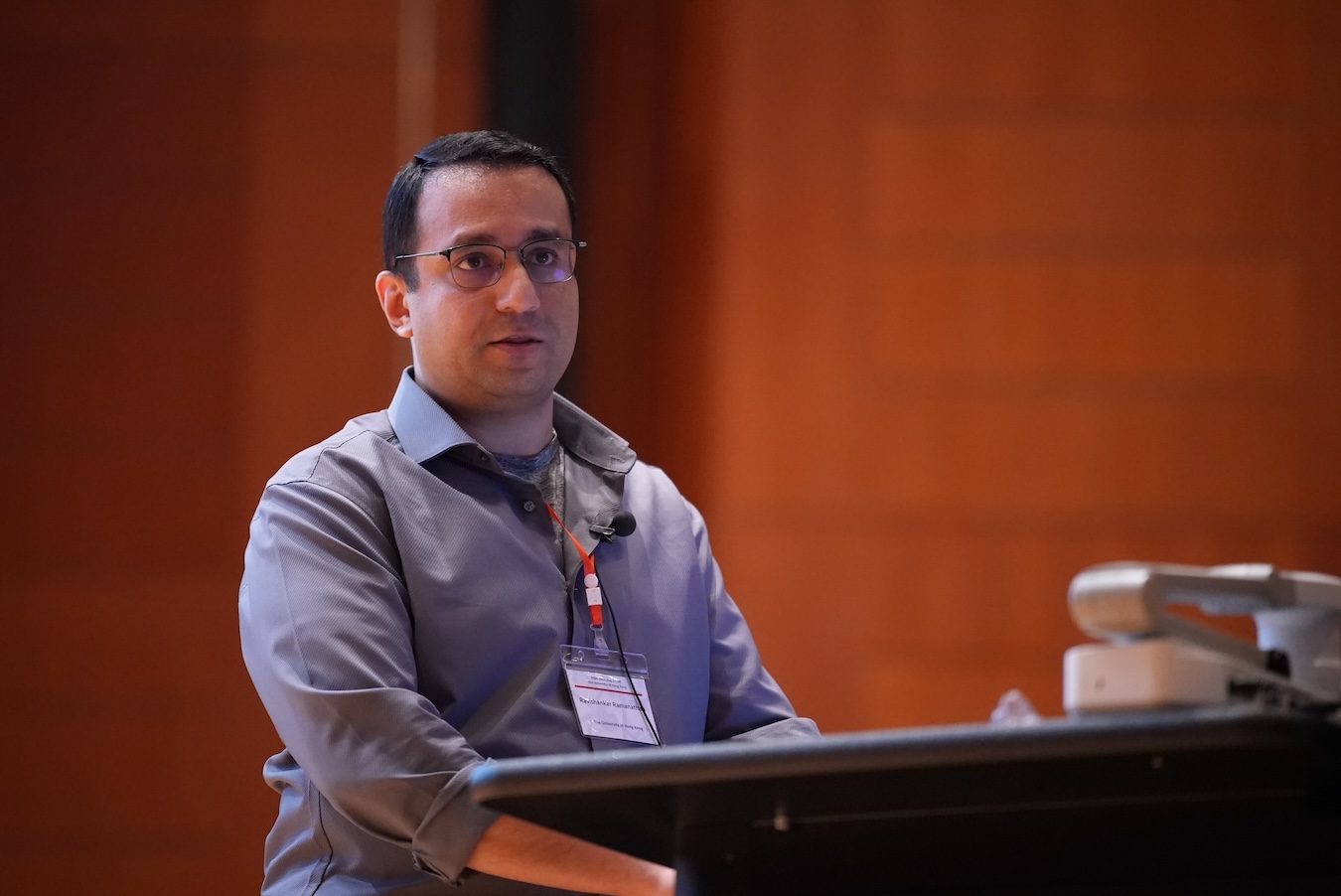
    When Randomness Becomes Intelligence: Ravi Ramanathan on Quantum Security and the Limits of AI

    “In both physics and life, uncertainty isn’t a flaw — it’s what keeps everything interesting.” — Prof. Ravi Ramanathan

    In a world driven by algorithms, certainty feels powerful. Yet for Professor Ravi Ramanathan of The University of Hong Kong’s School of Computing and Data Science (CDS), the opposite may be true.
    He studies how randomness and trust shape the future of both quantum security and artificial intelligence — two fields that depend on data, but also on doubt.


    From Theoretical Curiosity to Digital Trust

    Ramanathan’s path began in theoretical physics. He was fascinated by the strange mix of order and unpredictability inside quantum systems. Over time, that curiosity evolved into a question that now defines his research: Can uncertainty itself protect information?

    At HKU CDS, his group designs quantum cryptographic protocols that don’t rely on trusting the devices used to send or receive data. Instead, they use the laws of physics — not human assurances — to guarantee security.
    “It’s like replacing a lock built by people with one built by nature,” he says.


    Building Unhackable Systems

    Traditional encryption depends on mathematical puzzles that powerful computers might one day solve. Quantum cryptography flips that logic.
    It uses quantum particles, whose behavior changes when observed, to detect any eavesdropper immediately.

    Ramanathan’s work focuses on device-independent security — a method where users don’t even need to know how their devices are built. As long as the results obey specific quantum correlations, the communication is secure.

    This idea has major implications for AI as well. “AI systems make decisions based on patterns in data,” he explains. “If those data streams are ever compromised, the intelligence that depends on them becomes fragile. Quantum security keeps the foundation solid.”


    The AI Connection: Intelligence Without Certainty

    While most AI operates deterministically — producing the same output for the same input — the quantum world thrives on probabilities.
    Ramanathan believes that future forms of quantum AI may combine these two views of intelligence: the structured logic of algorithms and the creative randomness of quantum mechanics.

    “Learning,” he says, “might require a balance between prediction and surprise.”
    By introducing controlled randomness, quantum systems could explore possibilities that classical AI would never consider. The result might be machines that don’t just calculate outcomes — they imagine them.


    The Ethics of Uncertainty

    As AI becomes more autonomous, questions of control and trust follow closely behind. Ramanathan’s research in quantum randomness adds a unique ethical layer: unpredictability can protect privacy.
    “In cryptography, unpredictability is freedom,” he says. “If every decision were predictable, there would be no security — and no choice.”

    He often compares the challenge of securing algorithms to the challenge of keeping human decision-making free from bias. Both require space for uncertainty. Both depend on humility before complexity.


    Collaboration and Teaching at CDS

    At CDS, Ramanathan collaborates with Prof. Giulio Chiribella, Prof. Yuxiang Yang, and Prof. Qi Zhao to connect foundational theory with practical technology.
    He teaches courses that blend mathematics, physics, and computer science, encouraging students to question what it really means to “know” something in a computational world.

    His mentoring style mirrors his research: open-ended, curious, and slightly unpredictable. “Students learn best when they discover answers for themselves,” he notes.


    Looking Forward: Trusting Uncertainty

    Ramanathan sees a future where quantum communication and AI-driven reasoning merge into systems that are both intelligent and secure.
    These technologies may protect digital infrastructures, power next-generation networks, and even redefine how machines reason about risk.

    “Randomness is often seen as noise,” he says. “But in nature — and in intelligence — it’s also creativity. Embracing it might be our best safeguard in an age of perfect prediction.”

  • How Quantum Sensors Learn: Prof. Yuxiang Yang on Intelligence Beyond Silicon

    How Quantum Sensors Learn: Prof. Yuxiang Yang on Intelligence Beyond Silicon

    “To make better sensors, we need to teach them how to learn from the world around them.” — Prof. Yuxiang Yang

    When most people think about intelligence, they picture circuits and code — the realm of artificial intelligence. But for Professor Yuxiang Yang of the School of Computing and Data Science (CDS) at The University of Hong Kong, true intelligence may start not in software, but in how we sense reality itself.

    Yang’s research bridges the boundary between quantum physics and machine learning, using AI-driven methods to make quantum sensors more precise, adaptive, and even self-correcting. His work explores what happens when perception — human, mechanical, or quantum — becomes an intelligent process.


    A Physicist Who Thinks Like an Engineer

    Before arriving in Hong Kong, Yang trained as an optical physicist fascinated by the limits of measurement. “Every experiment,” he says, “is a conversation with nature. The better you listen, the more you understand.”

    Now at HKU CDS, he leads projects that bring AI algorithms into quantum laboratories, transforming how sensors detect the tiniest fluctuations in magnetic fields, light, or vibration. Where most people see noisy data, Yang sees a new kind of language — one that can be decoded through learning.


    The Science of Quantum Perception

    Quantum sensors exploit delicate quantum states to measure the world with extreme accuracy — detecting signals a billion times smaller than what conventional devices can capture. The challenge, however, is noise: every vibration, temperature shift, or stray photon can overwhelm the signal.

    Yang’s team tackles this by training AI models to separate meaningful information from random interference. Instead of manually tuning every parameter, algorithms learn to predict, filter, and adapt in real time. In effect, the sensor begins to “think” about its own environment.


    When Sensors Get Smarter

    The concept is revolutionary: a sensor that improves through experience. By combining reinforcement learning with quantum-optical hardware, Yang’s group designs systems that adjust their measurement strategies automatically.

    In one project, machine-learning routines identify patterns in experimental noise and recommend control settings that boost sensitivity. In another, neural-network architectures inspired by human vision help interpret complex interference patterns in light-based sensors.

    The results are striking — faster calibration, higher precision, and lower error rates. What used to take days of manual adjustment can now happen in minutes. “It’s like giving intuition to an instrument,” Yang says.


    The AI–Quantum Feedback Loop

    For Yang, the relationship between AI and quantum science runs both ways. Quantum experiments provide unique datasets that could inspire new machine-learning architectures; conversely, AI provides tools that push quantum systems to their limits.

    “Quantum systems don’t process information the way classical computers do,” he explains. “They can explore many possibilities at once. Understanding how they ‘learn’ from data may reshape how we define intelligence itself.”

    This feedback loop — between artificial learning and quantum understanding — is precisely where Yang believes future breakthroughs will occur.


    Mentorship and Collaboration at CDS

    At HKU CDS, Yang works closely with colleagues such as Prof. Giulio Chiribella, Prof. Ravi Ramanathan, and Prof. Qi Zhao in a research environment that encourages cross-disciplinary thinking.

    His students are trained not only to run experiments, but to write code, model data, and reason from first principles. Many take part in HKU’s Common Core course “The Quantum Revolution,” where Yang introduces AI-driven approaches to measurement as a window into the nature of knowledge itself.

    “We’re building a new generation of researchers who speak both languages — the language of physics and the language of data,” he says.


    Looking Ahead: Perception as Intelligence

    As AI systems become ubiquitous, Yang believes the next frontier is not only smarter computation but smarter perception — machines that can sense the world with the nuance of quantum systems.

    His vision is ambitious yet grounded: quantum sensors that monitor ecosystems, detect disease, or guide autonomous vehicles with unprecedented precision — all while learning continuously from the environment.

    “In the end,” he reflects, “AI and quantum physics are asking the same question: how do we extract meaning from uncertainty? The answer may begin with how we choose to observe.”

  • Prof. Giulio Chiribella: Rewriting the Rules of Reality

    Prof. Giulio Chiribella: Rewriting the Rules of Reality

    “If we change the way events can be ordered, we may discover new ways to compute, communicate, and understand the universe.” — Prof. Giulio Chiribella

    At the heart of modern physics lies a paradox: the deeper we go into the quantum world, the more reality seems to defy common sense. For Professor Giulio Chiribella, this mystery isn’t a roadblock — it’s the fuel for his life’s work. As a theoretical physicist and thought leader at HKU’s School of Computing and Data Science (CDS), Chiribella is rewriting the rules that govern how we understand time, information, and causality.


    An Early Fascination with Fundamental Questions

    Growing up in Italy, Chiribella was drawn not just to physics but to philosophy — asking questions about what’s real, what can be known, and how we represent the world. He earned his PhD at the University of Pavia, where his fascination with the mathematical structure of quantum theory began to crystallize. At Canada’s Perimeter Institute for Theoretical Physics, he established himself as one of the world leaders in a vibrant research community pushing the understanding of quantum foundations and the boundaries of theoretical physics. Later, he became a professor at the University of Oxford, deepening his exploration of the foundations of quantum mechanics.

    Now based in Hong Kong, Chiribella sees the city as a fertile ground for developing the next generation of quantum research — a place where abstract ideas can evolve into global impact.


    Foundations First: Indefinite Causality and Quantum Processes

    Much of Chiribella’s research centers on quantum foundations, particularly the concept of indefinite causal order — where cause and effect can be in a quantum superposition. In this framework, event A might cause event B and vice versa, simultaneously. These ideas aren’t just theoretical mind-benders. They’re opening doors to new types of quantum communication and computation that outperform even traditional quantum protocols.

    His work also explores process theories, abstract mathematical structures that describe physical systems more flexibly than conventional models. These tools help scientists test which parts of quantum theory are essential — and which might change in future theories.


    A Thought Experiment Across Time

    As someone who reshapes how we think about quantum theory itself, Chiribella often reflects on how far the field has come — and how much further it could go. When asked what he’d show to the pioneers of quantum physics, his answer reveals both reverence and ambition:

    “If we could go back and talk to Schrödinger, Heisenberg — or even Einstein — we could tell them that quantum theory can be written in a much more general way… not just using states, but processes. That would probably surprise them — in a good way.”

    Einstein, famously skeptical of the indeterminacy at the heart of quantum theory, might have found Chiribella’s process-based view provocative. Instead of smoothing over quantum strangeness, it embraces it — using tools like indefinite causality to explore new mathematical structures that go beyond classical intuition. While Einstein wanted a deeper reality beneath quantum randomness, Chiribella’s work suggests that the structure of reality itself may be fundamentally different — not deterministic, but richer and more relational than previously imagined.

    For Chiribella, it’s not just about solving problems within the rules — it’s about uncovering new rules entirely.


    From Thought Experiments to Technology

    While his thinking starts with fundamental questions, the implications are far-reaching. Chiribella’s frameworks are being applied in quantum machine learning, quantum communication networks, and quantum cryptography. He has co-authored seminal papers on quantum supermaps, causal networks, and programmable quantum processors — many of which laid the groundwork for today’s advances in distributed quantum computing.


    A Quantum Vision for Hong Kong

    As the founder of the Quantum Information, Computation and Intelligence (QICI) Lab at HKU, Chiribella is helping position Hong Kong as a global hub for quantum innovation. His leadership was instrumental in bringing AQIS 2025— Asia’s largest quantum conference — to Hong Kong for the first time. The event will convene leading theorists, experimentalists, and industry players to push the boundaries of what’s next.

    But beyond visibility, his vision is about cultivating a deep-thinking research culture — one that embraces foundational work as the seed of future technologies.


    The Quantum Team Around Him

    Chiribella’s activity has a positive impact throughout the whole QICI quantum team. His colleague Prof. Ravishankar Ramanathan carries forward ideas from the quantum foundations playbook into cryptographic protocols that don’t rely on trust. Prof. Yuxiang Yang complements the group with expertise in quantum sensors and applying AI to enhance their sensitivity. And Prof. Qi Zhao, a close collaborator, works at the intersection of quantum information theory and learning, investigating how quantum systems can process, compress, and extract information in ways that classical systems cannot.

    Together, they form a rare cluster of talent that spans both theory and experiment, foundations and applications — a hallmark of Chiribella’s approach to research and collaboration.


    Mentorship and Teaching: Nurturing Quantum Thinkers

    Chiribella is also known for his commitment to mentorship. In classes and labs, he encourages students to think like scientists, challenging assumptions rather than rushing to solve problems mechanically. His students are not just learning quantum mechanics — they’re exploring what it means to investigate reality.

    This mindset is embedded in HKU’s Common Core course, “The Quantum Revolution,” which Chiribella helped shape. It invites students from all disciplines to grapple with the counterintuitive features of quantum theory and reflect on its broader impact on knowledge and society.


    Looking Forward: Questions Still Unanswered

    As the world celebrates 100 years since the birth of quantum physics, the research in this area is far from done. Chiribella’s sights are set on exploring post-quantum theories, testing the boundaries of causality, and understanding how computation, information, and physical law interact.

    “The interplay between information, space, time, and matter is one of the most exciting frontiers of contemporary physics. If we manage to understand it, it will open the doors to new physics that we haven’t even imagined yet.”

    In a field defined by uncertainty, Chiribella’s work seeks clarity — not in final answers, but in how to ask the right questions. And through this work, Hong Kong is becoming a place where deep foundational questions can be explored at the cutting edge of science.