
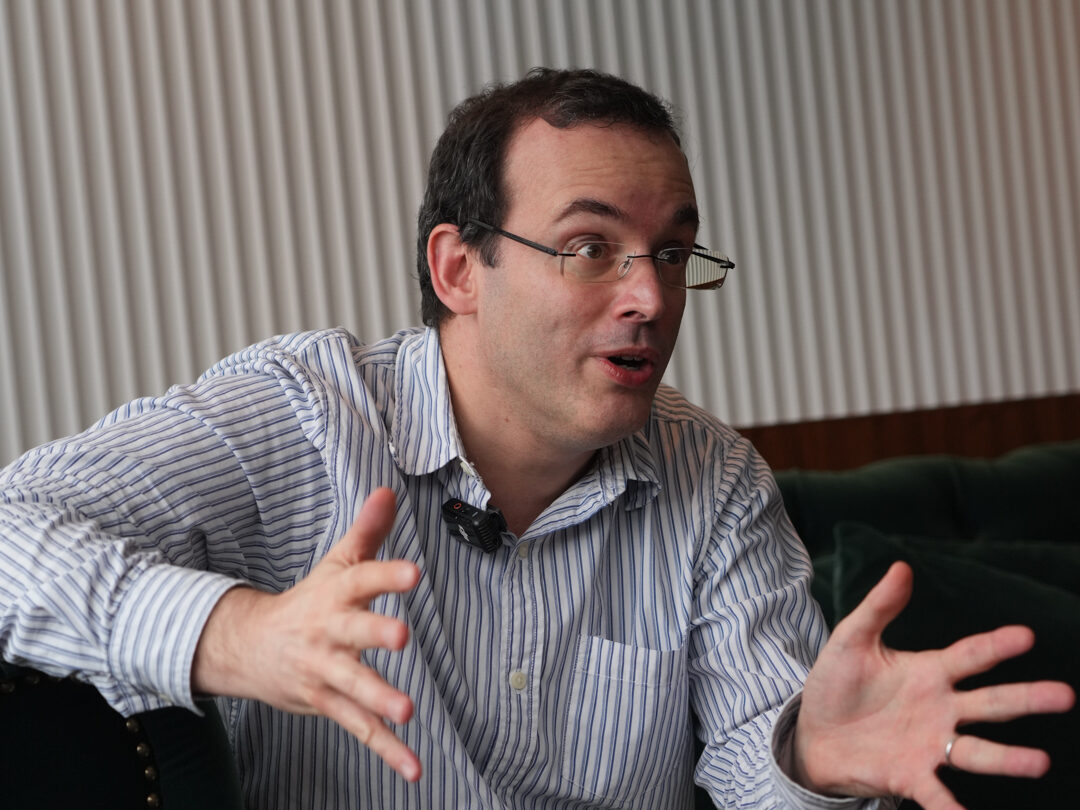
“If we change the way events can be ordered, we may discover new ways to compute, communicate, and understand the universe.” — Prof. Giulio Chiribella
At the heart of modern physics lies a paradox: the deeper we go into the quantum world, the more reality seems to defy common sense. For Professor Giulio Chiribella, this mystery isn’t a roadblock — it’s the fuel for his life’s work. As a theoretical physicist and thought leader at HKU’s School of Computing and Data Science (CDS), Chiribella is rewriting the rules that govern how we understand time, information, and causality.
An Early Fascination with Fundamental Questions
Growing up in Italy, Chiribella was drawn not just to physics but to philosophy — asking questions about what’s real, what can be known, and how we represent the world. He earned his PhD at the University of Pavia, where his fascination with the mathematical structure of quantum theory began to crystallize. At Canada’s Perimeter Institute for Theoretical Physics, he established himself as one of the world leaders in a vibrant research community pushing the understanding of quantum foundations and the boundaries of theoretical physics. Later, he became a professor at the University of Oxford, deepening his exploration of the foundations of quantum mechanics.
Now based in Hong Kong, Chiribella sees the city as a fertile ground for developing the next generation of quantum research — a place where abstract ideas can evolve into global impact.
Foundations First: Indefinite Causality and Quantum Processes
Much of Chiribella’s research centers on quantum foundations, particularly the concept of indefinite causal order — where cause and effect can be in a quantum superposition. In this framework, event A might cause event B and vice versa, simultaneously. These ideas aren’t just theoretical mind-benders. They’re opening doors to new types of quantum communication and computation that outperform even traditional quantum protocols.
His work also explores process theories, abstract mathematical structures that describe physical systems more flexibly than conventional models. These tools help scientists test which parts of quantum theory are essential — and which might change in future theories.
A Thought Experiment Across Time
As someone who reshapes how we think about quantum theory itself, Chiribella often reflects on how far the field has come — and how much further it could go. When asked what he’d show to the pioneers of quantum physics, his answer reveals both reverence and ambition:
“If we could go back and talk to Schrödinger, Heisenberg — or even Einstein — we could tell them that quantum theory can be written in a much more general way… not just using states, but processes. That would probably surprise them — in a good way.”
Einstein, famously skeptical of the indeterminacy at the heart of quantum theory, might have found Chiribella’s process-based view provocative. Instead of smoothing over quantum strangeness, it embraces it — using tools like indefinite causality to explore new mathematical structures that go beyond classical intuition. While Einstein wanted a deeper reality beneath quantum randomness, Chiribella’s work suggests that the structure of reality itself may be fundamentally different — not deterministic, but richer and more relational than previously imagined.
For Chiribella, it’s not just about solving problems within the rules — it’s about uncovering new rules entirely.
From Thought Experiments to Technology
While his thinking starts with fundamental questions, the implications are far-reaching. Chiribella’s frameworks are being applied in quantum machine learning, quantum communication networks, and quantum cryptography. He has co-authored seminal papers on quantum supermaps, causal networks, and programmable quantum processors — many of which laid the groundwork for today’s advances in distributed quantum computing.
A Quantum Vision for Hong Kong
As the founder of the Quantum Information, Computation and Intelligence (QICI) Lab at HKU, Chiribella is helping position Hong Kong as a global hub for quantum innovation. His leadership was instrumental in bringing AQIS 2025— Asia’s largest quantum conference — to Hong Kong for the first time. The event will convene leading theorists, experimentalists, and industry players to push the boundaries of what’s next.
But beyond visibility, his vision is about cultivating a deep-thinking research culture — one that embraces foundational work as the seed of future technologies.
The Quantum Team Around Him
Chiribella’s activity has a positive impact throughout the whole QICI quantum team. His colleague Prof. Ravishankar Ramanathan carries forward ideas from the quantum foundations playbook into cryptographic protocols that don’t rely on trust. Prof. Yuxiang Yang complements the group with expertise in quantum sensors and applying AI to enhance their sensitivity. And Prof. Qi Zhao, a close collaborator, works at the intersection of quantum information theory and learning, investigating how quantum systems can process, compress, and extract information in ways that classical systems cannot.
Together, they form a rare cluster of talent that spans both theory and experiment, foundations and applications — a hallmark of Chiribella’s approach to research and collaboration.
Mentorship and Teaching: Nurturing Quantum Thinkers
Chiribella is also known for his commitment to mentorship. In classes and labs, he encourages students to think like scientists, challenging assumptions rather than rushing to solve problems mechanically. His students are not just learning quantum mechanics — they’re exploring what it means to investigate reality.
This mindset is embedded in HKU’s Common Core course, “The Quantum Revolution,” which Chiribella helped shape. It invites students from all disciplines to grapple with the counterintuitive features of quantum theory and reflect on its broader impact on knowledge and society.
Looking Forward: Questions Still Unanswered
As the world celebrates 100 years since the birth of quantum physics, the research in this area is far from done. Chiribella’s sights are set on exploring post-quantum theories, testing the boundaries of causality, and understanding how computation, information, and physical law interact.
“The interplay between information, space, time, and matter is one of the most exciting frontiers of contemporary physics. If we manage to understand it, it will open the doors to new physics that we haven’t even imagined yet.”
In a field defined by uncertainty, Chiribella’s work seeks clarity — not in final answers, but in how to ask the right questions. And through this work, Hong Kong is becoming a place where deep foundational questions can be explored at the cutting edge of science.
Leave a Reply