
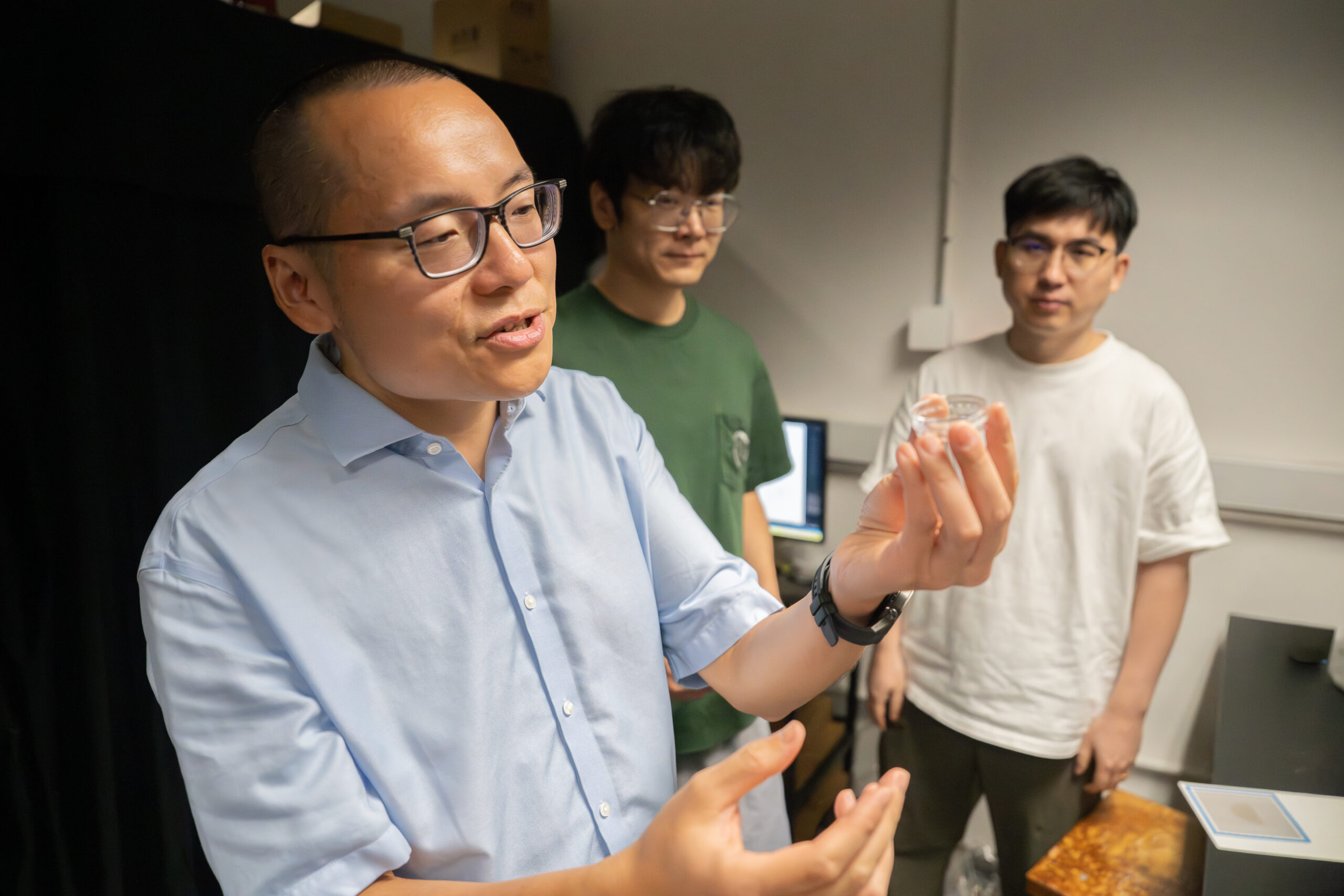
“One of the biggest limitations in fields like AI is power consumption, and the key bottleneck is that their semiconductors are based on silicon.”
— Professor Chu Zhiqin
Most people know diamonds as age-old symbols of eternal love, but to the University of Hong Kong’s Professor Chu Zhiqin, they’re the key to our technological future.
It’s no exaggeration to say that that we’re living in the age of silicon. The element has become the building block of modernity, powering the semiconductors in everything from precision medical equipment to our phones. But silicon is far from an ideal conductor, and scientists have long dreamed of fashioning superior alternatives out of more suitable materials like diamonds.
The challenge lies in the very attributes that make diamonds so desirable: their durability and toughness. How can you grow diamonds that aren’t just better conductors than silicon, but also have the flexibility needed for the next generation of computing devices, including both power-intensive uses like AI and difficult-to-manufacture wearables?
That’s where Professor Chu comes in. His research – for which he was just named a finalist in the prestigious Falling Walls Science Breakthrough awards – is revolutionising the field of diamond-based semiconductors, heralding the future arrival of flexible yet durable chips with more than 10 times the thermal conductivity of their silicon counterparts.
The Future of Semiconductors
In theory, diamonds are almost the perfect vehicles for a future “fourth generation” of semiconductors. They are relatively easy to grow – all you need is hydrogen, methane, and electricity – strong, and can handle far higher wattages and more heat than silicon.
The trick is in manufacturing. While the basic process is well established, researchers have long struggled to produce diamond structures suitable for next-generation devices like wearables: ones that are flexible without sacrificing durability.
Cracking the code took Professor Chu and his team over a year of hard work. But they finally developed a trade secret process that allows them to reliably produce high-quality, micrometre-thin diamond semiconductors that can be rolled and flexed like sheets of paper.
“That’s the beauty of being a scientist: You know more about your field than anyone else in the world. If you dig long enough and hard enough, no one will be better at it than you.”
— Professor Chu Zhiqin
The Next Generation of Computing
The barriers to replication are steep: Although the team’s work has already spawned imitators, the competing diamonds tend to crack quickly, Professor Chu says, making them unsuitable for industrial uses.
The next challenge is commercialisation. Professor Chu is trying to interest manufacturers – always difficult with any new material – and is focusing his energies on high-upside, future-centric sectors like heat spreaders for GPUs and electric vehicles. If they succeed, they could radically increase the efficiency of some of the world’s most important products.
Among the developments Professor Chu is keeping his eye on are new AI-based measuring tools. Although accumulating training data remains difficult, AI offers more efficient, dynamic measurements. “Everything can be analysed by AI,” Professor Chu says. “It tells us what the best measurement parameters are.”
“Basically, the way we’re doing measurements now is the Stone Age, but with AI, we can move forward.”
— Professor Chu Zhiqin
A Scientific Spirit
But Professor Chu isn’t solely fixated on cutting-edge technologies. As the interview winds down, he muses on another significant challenge facing the field: cultivating the next generation of scientists.
Many aspiring scientists find the process discouraging and gradually drift away from the field. “They think learning math is hard, and learning physics is boring,” he says, adding that they can’t see how they’re supposed to master everything.
That’s an unfortunate misconception, Professor Chu believes. “Scientists actually are highly specialised,” he says. “It’s not that scientists can solve everything, but we can solve a few, very specific things.”
This preoccupation is reflected in his lab’s work. When asked what his favourite device is, he doesn’t mention the powerful Zeiss microscope, but a miniature quantum mechanics learning kit developed by one of his graduate students, Madhav. The box allows teachers to show young students quantum mechanics in action, rather than theory, letting them experience for themselves what it’s like to be a scientist.
It may seem small – or an unusual project for a lab of this stature – but it’s just one more way Professor Chu and his team are shaping the future of science.
Leave a Reply