
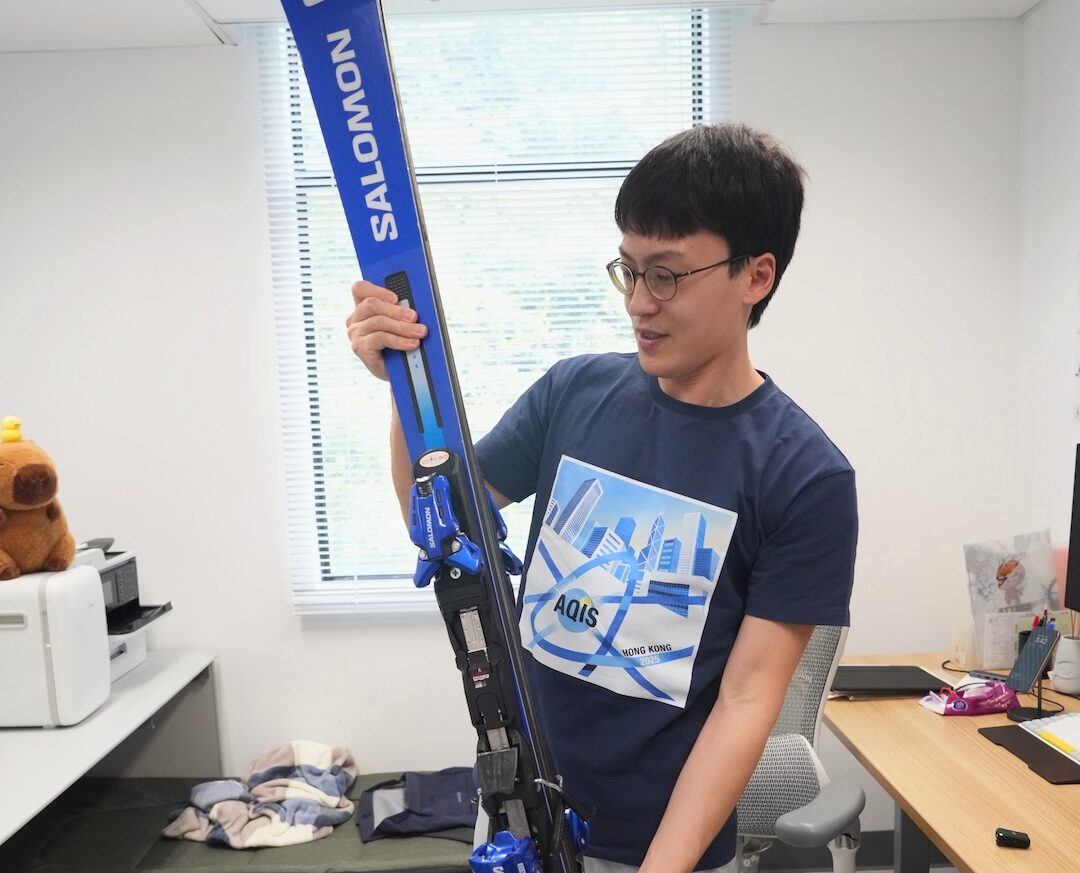
“To make better sensors, we need to teach them how to learn from the world around them.” — Prof. Yuxiang Yang
When most people think about intelligence, they picture circuits and code — the realm of artificial intelligence. But for Professor Yuxiang Yang of the School of Computing and Data Science (CDS) at The University of Hong Kong, true intelligence may start not in software, but in how we sense reality itself.
Yang’s research bridges the boundary between quantum physics and machine learning, using AI-driven methods to make quantum sensors more precise, adaptive, and even self-correcting. His work explores what happens when perception — human, mechanical, or quantum — becomes an intelligent process.
A Physicist Who Thinks Like an Engineer
Before arriving in Hong Kong, Yang trained as an optical physicist fascinated by the limits of measurement. “Every experiment,” he says, “is a conversation with nature. The better you listen, the more you understand.”
Now at HKU CDS, he leads projects that bring AI algorithms into quantum laboratories, transforming how sensors detect the tiniest fluctuations in magnetic fields, light, or vibration. Where most people see noisy data, Yang sees a new kind of language — one that can be decoded through learning.
The Science of Quantum Perception
Quantum sensors exploit delicate quantum states to measure the world with extreme accuracy — detecting signals a billion times smaller than what conventional devices can capture. The challenge, however, is noise: every vibration, temperature shift, or stray photon can overwhelm the signal.
Yang’s team tackles this by training AI models to separate meaningful information from random interference. Instead of manually tuning every parameter, algorithms learn to predict, filter, and adapt in real time. In effect, the sensor begins to “think” about its own environment.
When Sensors Get Smarter
The concept is revolutionary: a sensor that improves through experience. By combining reinforcement learning with quantum-optical hardware, Yang’s group designs systems that adjust their measurement strategies automatically.
In one project, machine-learning routines identify patterns in experimental noise and recommend control settings that boost sensitivity. In another, neural-network architectures inspired by human vision help interpret complex interference patterns in light-based sensors.
The results are striking — faster calibration, higher precision, and lower error rates. What used to take days of manual adjustment can now happen in minutes. “It’s like giving intuition to an instrument,” Yang says.
The AI–Quantum Feedback Loop
For Yang, the relationship between AI and quantum science runs both ways. Quantum experiments provide unique datasets that could inspire new machine-learning architectures; conversely, AI provides tools that push quantum systems to their limits.
“Quantum systems don’t process information the way classical computers do,” he explains. “They can explore many possibilities at once. Understanding how they ‘learn’ from data may reshape how we define intelligence itself.”
This feedback loop — between artificial learning and quantum understanding — is precisely where Yang believes future breakthroughs will occur.
Mentorship and Collaboration at CDS
At HKU CDS, Yang works closely with colleagues such as Prof. Giulio Chiribella, Prof. Ravi Ramanathan, and Prof. Qi Zhao in a research environment that encourages cross-disciplinary thinking.
His students are trained not only to run experiments, but to write code, model data, and reason from first principles. Many take part in HKU’s Common Core course “The Quantum Revolution,” where Yang introduces AI-driven approaches to measurement as a window into the nature of knowledge itself.
“We’re building a new generation of researchers who speak both languages — the language of physics and the language of data,” he says.
Looking Ahead: Perception as Intelligence
As AI systems become ubiquitous, Yang believes the next frontier is not only smarter computation but smarter perception — machines that can sense the world with the nuance of quantum systems.
His vision is ambitious yet grounded: quantum sensors that monitor ecosystems, detect disease, or guide autonomous vehicles with unprecedented precision — all while learning continuously from the environment.
“In the end,” he reflects, “AI and quantum physics are asking the same question: how do we extract meaning from uncertainty? The answer may begin with how we choose to observe.”