
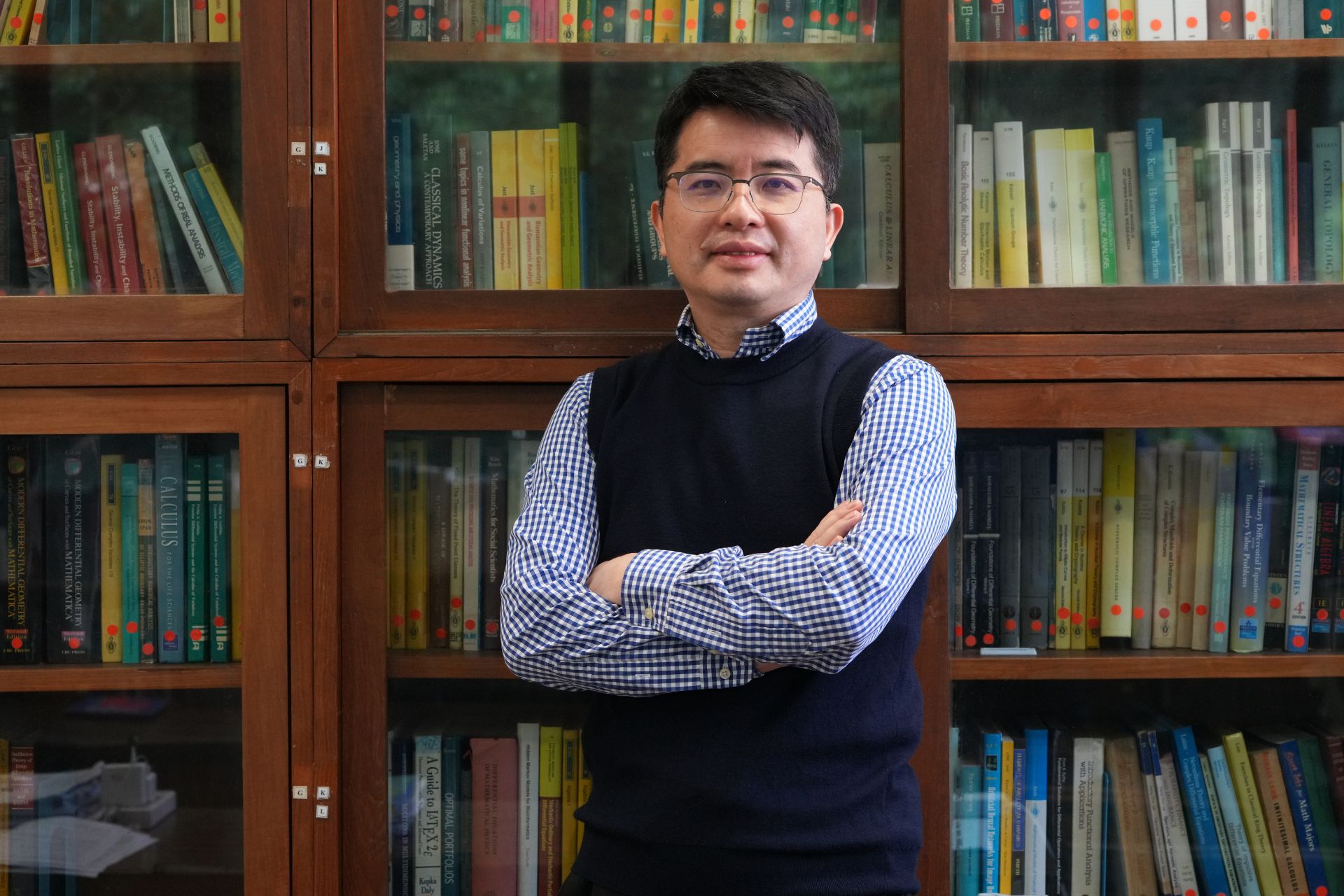
Professor Yuan Xiaoming works in the Department of Mathematics at HKU. An accomplished mathematician and scientist, he was three times voted highly cited researcher by Clarivate Analytics. Professor Yuan’s main speciality is optimisation, and he applies this expertise in the field of artificial intelligence. In this interview with our science editor Dr Pavel Toropov, Professor Yuan explains the importance of mathematics in AI.
❓ Dr Pavel Toropov: What is the role of a mathematician in AI?
💬 Professor Yuan Xiaoming: Our role is fundamental, a foundation. I can prove it – when people talk about AI, you usually only hear about the engineering side, the programming, the implementation of the product. But – breakthroughs in AI depend on how good you are at maths! What does AI mean? Intelligence created by people. And how do you get intelligence? One answer is maths!
❓ What do you mean by this?
💬 AI is artificial – fake intelligence, intelligence in the machine. AI is not fake, of course, but it is computational intelligence. And, who tells the computer to generate this intelligence? Humans, people. So, you need human intelligence – in your brain – to do AI better. And maths is the best way to improve your intelligence, your level of thinking, your logic.
❓ So mathematics is like training, going to the gym, but for the brain?
💬 Yes. Mathematics is brain training.
❓ What is your main area in the field of AI?
💬 Optimisation (algorithms). There are a lot of optimization problems in the AI industry. For example, if we want to minimise the bandwidth cost for a livestreaming business, that’s an optimisation problem.
You understand the questions from a maths perspective and design fast, efficient and robust algorithms to solve them. These are purely maths problems. We work on such problems.
❓ You also work a lot with the industry, designing algorithms for commercial application. How do you use maths there?
💬 For example, something that everyone is talking about now – LLM, large language models, like Chat GPT and variants of that. In LLM there are several stages – pre-training, post-training, fine-tuning. Each stage has a lot of optimisation problems.
For example, LLM has a lot of connections between different neurons, and in the post-training stage you have to cut some of these connections to save the hardware computation facilities, like memory. Which neurones can be cut off? We design a mathematical model to help do this and it can save a lot of computation facilities – and that’s money.
❓ You also work with AI chips. What is an AI chip?
💬 Traditionally the concept of computer chips is just hardware. But now people integrate algorithms into the chip so that it works faster. We design algorithms into the chip to accelerate the computation in the chip.
One type of standard, representative work is vectors and matrix decomposition, matrix and vector multiplication. We design specific algorithms to try to make the computation of vectors and matrix more efficient.
Sometimes a structure has to be introduced into the chip. For example, the most popular chips, like Nvidia A100 and H100, have specific structures – that’s why they work so well. One typical structure is sparse tensor core, designed to accelerate sparse matrix computations, and we have to design algorithms to fit into such hardware structures.
❓ Where does HKU compare to other institutions when it comes to innovation in the field of AI and mathematics?
💬 HKU is a good place to do AI-related topics. I am a maths professor, and for AI we need to do a lot of maths. Theory-wise we are quite strong – HKU attracts good postgrad students, and I am very happy to be working with such good students. I also launched an AI program with the Department of Statistics and the Department of Computer Science. This program provides new resources, manpower for our projects.
❓ Tech jobs – software engineers, programmers, are coveted because they offer good pay and are in demand. Are there career opportunities for mathematicians?
💬 I can see a direct link between maths and commercial value. I know that many people do not have any idea about this – maths is just formulas on paper, they have nothing to do with business, but I am an example – I save money for industry.
I am a mathematician, and I can help industry earn a lot of money. I recently helped Huawei, with my algorithms, to save USD108 million, in less than three years. That’s commercial value! I designed the algorithms which helped them save money because of benefits costs for their livestream business, which is one of the most important parts of the digital economy, as business professors like to call it.
And – what is the specific meaning of “digital economy”? Digital means numbers, numbers on the computer. Creating meaningful knowledge from numbers depends on numerical algorithms, so it depends on mathematical knowledge.
Therefore, the mathematical foundation for AI is really important. We are not doing AI incrementally, little by little – mathematicians can help industry with breakthrough ideas! The importance of mathematicians in AI must be highlighted.
❓ Final question: would you recommend mathematics as a career?
💬 Of course!
👏 Thank you, Professor Yuan.