
One ostracod is one white dot on the slide. In one second AI can identify 20 of them. There are several hundred ostracods here on this slide. Identification will take a few minutes for AI, but by eye, depending on the person – one day, or several hours.
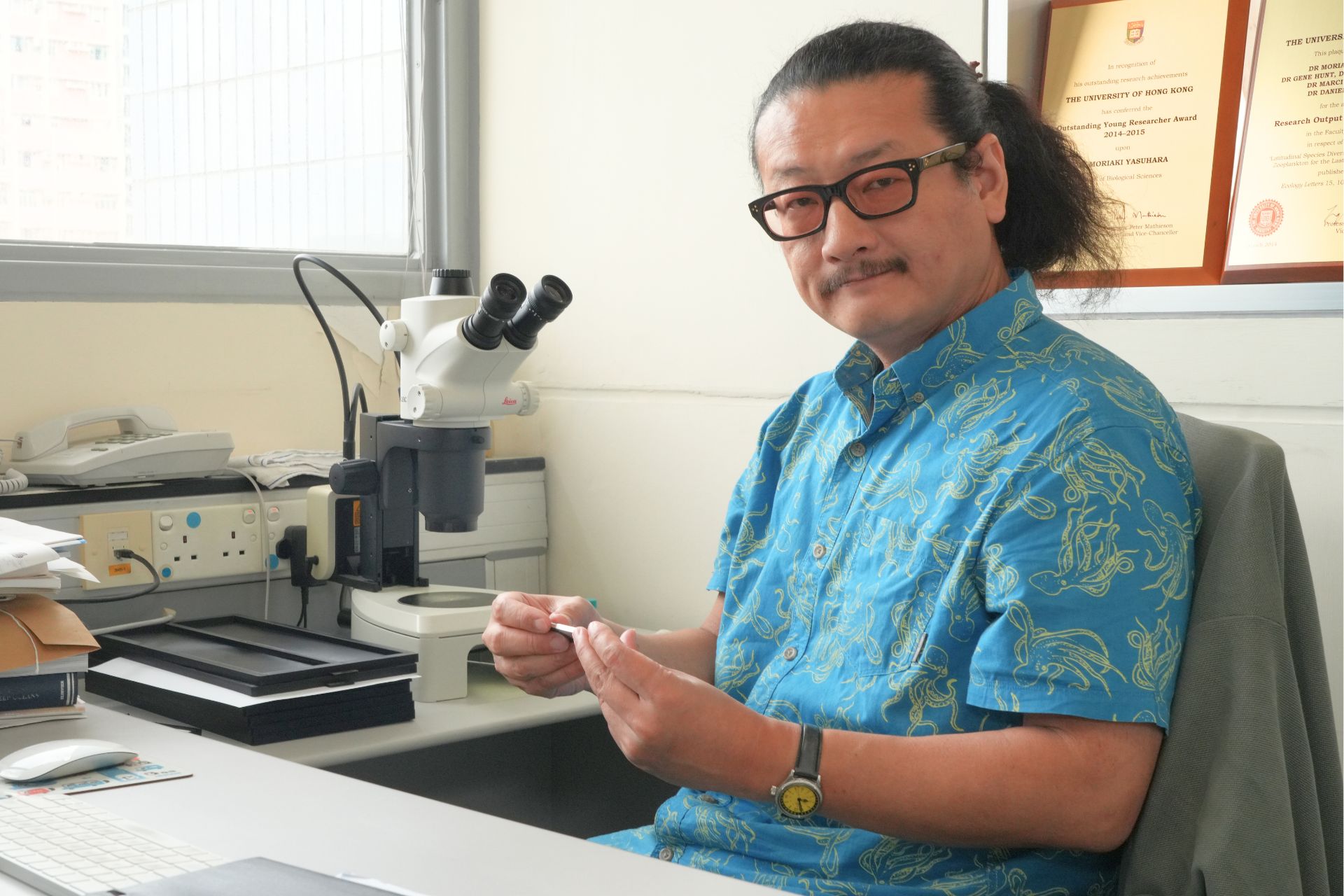
Professor Moriaki Yasuhara works at the Swire Institute of Marine Science, the School of Biological Sciences. One of his main research interests is paleoecology – the interaction of ancient organisms and their environment. In this interview with our science editor Dr Pavel Toropov, Professor Yasuhara and his PhD student Jiamian Hu explain how AI deep learning tools have transformed their research.
❓ Dr Pavel Toropov: could you explain what the direction is of the research done by your laboratory?
💬 Professor Moriaki Yasuhara: We want to understand the climatic and environmental impact on our planet, especially on marine ecosystems and biodiversity. We are interested in how climate change, global warming, acidification, and oxygen decline effect marine animals.
Our laboratory focuses on paleobiology. We study marine biology, but over longer time scales, using the fossil record. In contemporary biology, scientists start monitoring after they realise there is a problem. Once they realise there is, for example, pollution, they start monitoring. But we don’t know what the natural environmental conditions were before pollution.
But, by studying sediment cores and deep time fossil record, we have long time series throughout – before and after. We can go back hundreds of thousands, tens of millions or even hundreds of millions of years.
❓ Dr Pavel Toropov: What animals do you use in the fossil record?
💬 Professor Moriaki Yasuhara: Most animals – fish, jelly fish, worms, marine mammals – don’t have a good fossil record as they have no hard parts, for example shells, that allow for good fossil preservation. Or, they are too large to be abundantly preserved in a small amount of sediments as fossils. So, we need a representative, a surrogate, to make conclusions about the global marine ecosystem.
One representative is ostracods. They are tiny crustaceans with really nice calcium carbonate shells, and they have some of the best fossil records amongst all crustaceans, arthropods, and metazoans.
So, by studying ostracods, we can know not only about ostracods themselves, but, using them as a representative, learn about the entire ecosystem, the entire biodiversity.
❓ Dr Pavel Toropov: Where do your ostracods come from?
💬 Professor Moriaki Yasuhara: Mainly from the Cenozoic Era – from 66 million years ago to the present. Some of my students are working on Ordovician samples – from more than 400 million years ago. My research locations include the Arctic, Antarctic, Atlantic Ocean, Indian Ocean, Pacific Ocean, Red Sea, Mediterranean Sea… Hong Kong, Africa.
❓ Dr Pavel Toropov: So, to explain your work in simple terms: you get a core sample of the sediment from the bottom of the sea, take out all the tiny ostracods, put them on the microscope slide. Then you identify what species they are. Because different species prefer different conditions, by knowing how the numbers of different species of ostracods changed with time, you can make conclusions on the changes in the entire marine ecosystem, correct?
💬 Professor Moriaki Yasuhara: Yes.
❓ Dr Pavel Toropov: How do you use AI in this?
💬 Professor Moriaki Yasuhara There are several problems (working with ostracods). First, it is very time consuming – picking, identification, taxonomy. Also, we need expert knowledge. To train one person to be good at ostracod identification and taxonomy takes many years. An entire PhD is probably necessary.
Recently, I have been working with my PhD student Hugo Jiamian Hu to automate this process by applying AI deep learning. He did a very good job, and now we can scan entire slides automatically, using our digital microscope.
Hugo used more than 200,000 ostracod specimens for training our AI, and now the AI can do its own automatic identification. Identification is now much faster, and we can use much bigger data.
💬 Jiamian Hu: Yes, and having a lot of data, big data, means quite something! The 200,000 research-grade, specialist-identified samples ensure that our deep neural network can effectively learn patterns in ostracod identification.
❓ Dr Pavel Toropov: How much time does using AI save you?
💬 Jiamian Hu: We have a PhD student who has about a hundred samples of ostracods from Panama. Before AI, by hand, one by one, it may take her several days to finish a sample. Now, using AI – less than an hour.
(Shows a microscope slide with ostracods) One ostracod is one white dot on the slide. In one second AI can identify 20 of them. There are several hundred ostracods here on this slide. Identification will take a few minutes for AI, but by eye, depending on the person – one day, or several hours.
In addition, Professor Yasuhara is not always free, but AI is always free. So, when student has a question about identification, AI can always help.
❓ Dr Pavel Toropov: Did you write this deep learning program yourself?
💬 Jiamian Hu: I wrote it with PyTouch. I built it from scratch, it is specifically designed. I was a computer science student before.
💬 Professor Yasuhara: Not only is AI more time efficient, by using AI, deep learning, we made exciting discoveries, learned new things. AI can discover errors, misidentifications. AI can give you new questions to answer.
👏 Dr Pavel Toropov: Thank you both.