
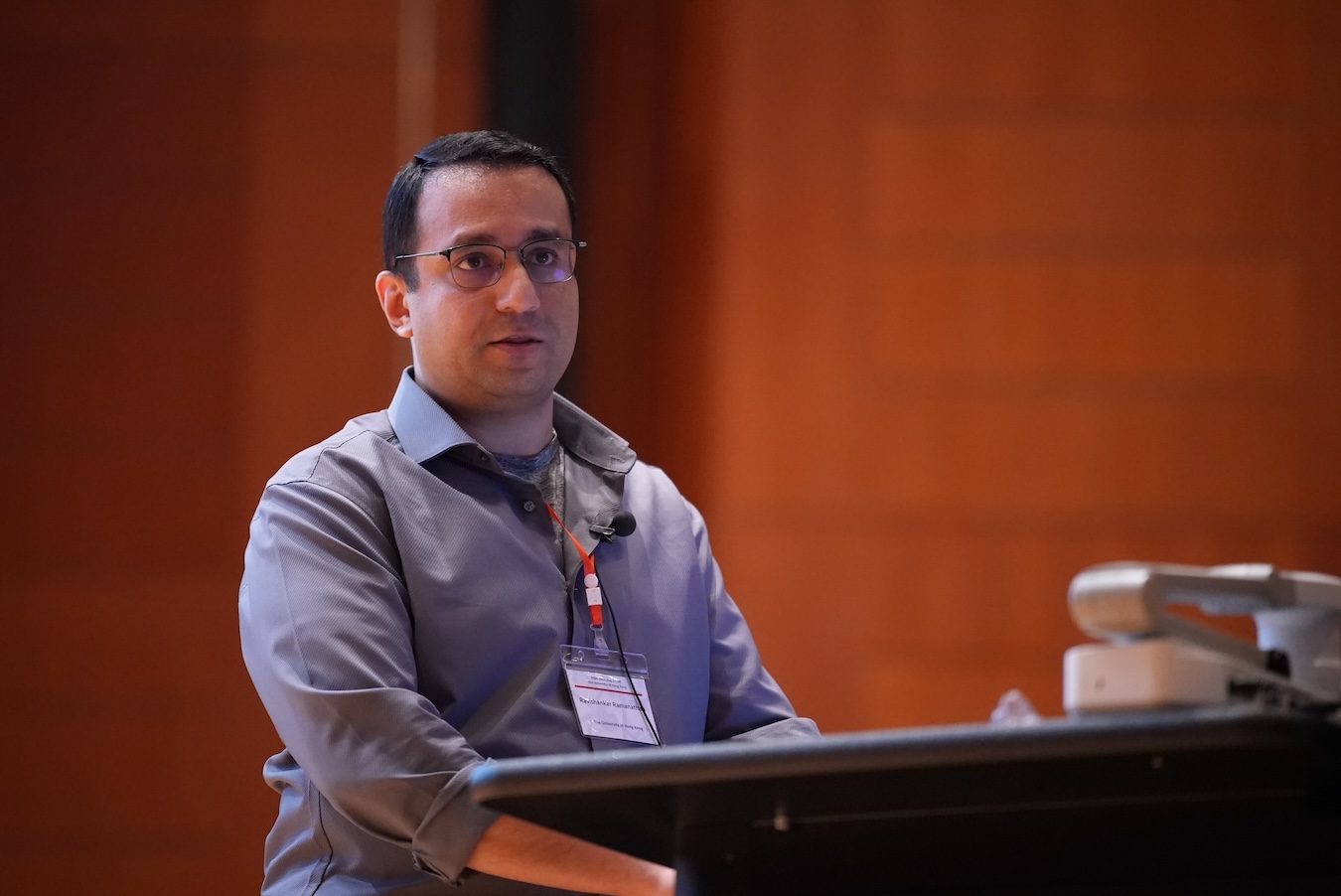
“In both physics and life, uncertainty isn’t a flaw — it’s what keeps everything interesting.” — Prof. Ravi Ramanathan
In a world driven by algorithms, certainty feels powerful. Yet for Professor Ravi Ramanathan of The University of Hong Kong’s School of Computing and Data Science (CDS), the opposite may be true.
He studies how randomness and trust shape the future of both quantum security and artificial intelligence — two fields that depend on data, but also on doubt.
From Theoretical Curiosity to Digital Trust
Ramanathan’s path began in theoretical physics. He was fascinated by the strange mix of order and unpredictability inside quantum systems. Over time, that curiosity evolved into a question that now defines his research: Can uncertainty itself protect information?
At HKU CDS, his group designs quantum cryptographic protocols that don’t rely on trusting the devices used to send or receive data. Instead, they use the laws of physics — not human assurances — to guarantee security.
“It’s like replacing a lock built by people with one built by nature,” he says.
Building Unhackable Systems
Traditional encryption depends on mathematical puzzles that powerful computers might one day solve. Quantum cryptography flips that logic.
It uses quantum particles, whose behavior changes when observed, to detect any eavesdropper immediately.
Ramanathan’s work focuses on device-independent security — a method where users don’t even need to know how their devices are built. As long as the results obey specific quantum correlations, the communication is secure.
This idea has major implications for AI as well. “AI systems make decisions based on patterns in data,” he explains. “If those data streams are ever compromised, the intelligence that depends on them becomes fragile. Quantum security keeps the foundation solid.”
The AI Connection: Intelligence Without Certainty
While most AI operates deterministically — producing the same output for the same input — the quantum world thrives on probabilities.
Ramanathan believes that future forms of quantum AI may combine these two views of intelligence: the structured logic of algorithms and the creative randomness of quantum mechanics.
“Learning,” he says, “might require a balance between prediction and surprise.”
By introducing controlled randomness, quantum systems could explore possibilities that classical AI would never consider. The result might be machines that don’t just calculate outcomes — they imagine them.
The Ethics of Uncertainty
As AI becomes more autonomous, questions of control and trust follow closely behind. Ramanathan’s research in quantum randomness adds a unique ethical layer: unpredictability can protect privacy.
“In cryptography, unpredictability is freedom,” he says. “If every decision were predictable, there would be no security — and no choice.”
He often compares the challenge of securing algorithms to the challenge of keeping human decision-making free from bias. Both require space for uncertainty. Both depend on humility before complexity.
Collaboration and Teaching at CDS
At CDS, Ramanathan collaborates with Prof. Giulio Chiribella, Prof. Yuxiang Yang, and Prof. Qi Zhao to connect foundational theory with practical technology.
He teaches courses that blend mathematics, physics, and computer science, encouraging students to question what it really means to “know” something in a computational world.
His mentoring style mirrors his research: open-ended, curious, and slightly unpredictable. “Students learn best when they discover answers for themselves,” he notes.
Looking Forward: Trusting Uncertainty
Ramanathan sees a future where quantum communication and AI-driven reasoning merge into systems that are both intelligent and secure.
These technologies may protect digital infrastructures, power next-generation networks, and even redefine how machines reason about risk.
“Randomness is often seen as noise,” he says. “But in nature — and in intelligence — it’s also creativity. Embracing it might be our best safeguard in an age of perfect prediction.”